
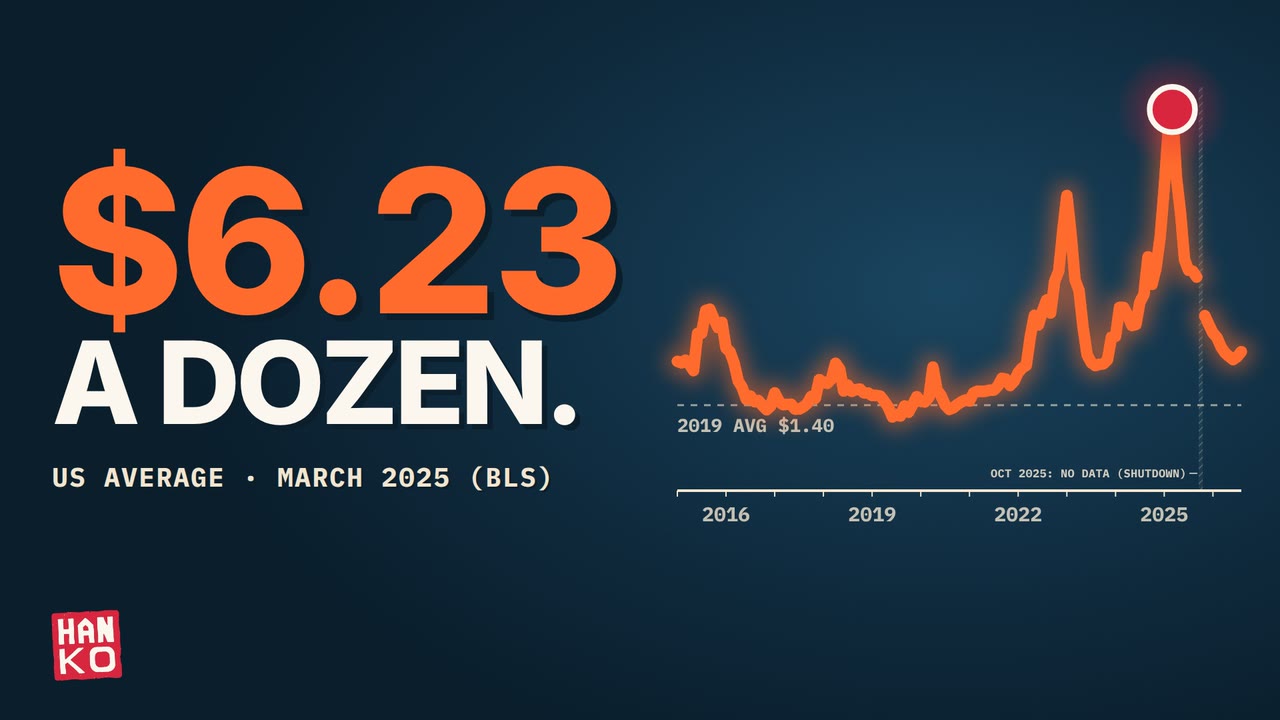
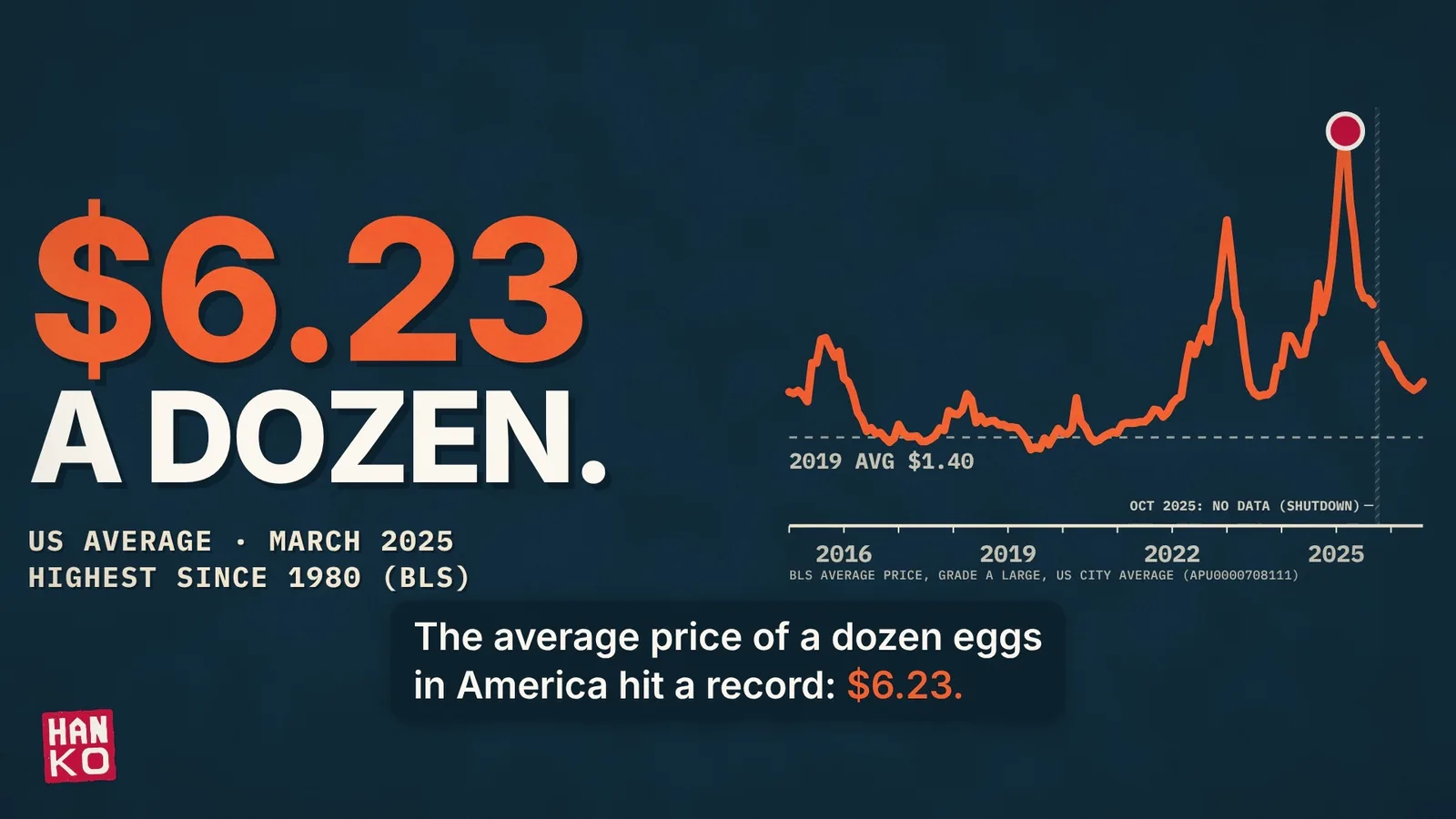
US egg prices quadrupled because bird flu hit flocks holding about one in seven of America’s egg-laying hens in a single winter, and buyers could not easily do without eggs. The average price of a dozen reached $6.23 in March 2025, a record for the Bureau of Labor Statistics series that starts in 1980 and 4.46 times the 2019 average of about $1.40 (BLS; USDA APHIS; USDA NASS; our math). Prices crashed when outbreaks slowed, flocks refilled and panic buying faded: by August 2026 the average was $2.27, 63.5% below the peak (USDA ERS; SEC filing; BLS; our math).
The $6.23 is an average across US stores; some shoppers paid more, some less. At the peak it came to almost 52 cents an egg (BLS; our math).
2019: about $1.40 a dozen
In 2019 a dozen averaged about $1.40, or 11.6 cents an egg (BLS; our math), and New York’s wholesale price, what big buyers pay, averaged 94 cents (USDA ERS). Eggs leave the farm at a wholesale price, and the shelf price follows it (USDA ERS).
2022: bird flu arrives
On 8 February 2022, the outbreak reached its first commercial farm, a turkey flock in Dubois County, Indiana (USDA APHIS; USDA APHIS). Infected flocks are culled whole to stop the spread (CRS), and the typical egg-laying flock hit held 923,600 hens, our median of APHIS data (USDA APHIS; our math).
By 1 June 2022 the table-egg flock had fallen 7.8%, from 326.0 million to 300.4 million (USDA NASS; our math). The average dozen reached $4.82 in January 2023, the series high at the time and about 140% above February 2022 (BLS; CRS; our math). Then layer farms went from January to October 2023 without a new detection, and the price slid back to about $2 (USDA APHIS; BLS). A flock less than a tenth smaller had more than doubled the price.
Why a small shortage makes a big price
The video’s imaginary market shows why: ten shoppers, ten cartons. Take one away and somebody leaves without eggs. If eggs were easy to give up, someone would walk away and the price would barely move. But eggs are breakfast, baking and an ingredient in many foods, so everyone bids higher until somebody finally gives up.
Economists call that inelastic demand. In the Congressional Research Service’s words, “relatively small changes in supply can have large effects on price” (CRS). Demand still matters; it just does not stretch much.
USDA’s eggs-per-person figure (supply divided by population, including eggs in processed food) fell about 9.6% from 2019 to 2025 (USDA ERS). With 2019 at 100, that is 90 for eggs per person against 446 for the shelf price at its peak (our math). People cut back a little; the price did most of the adjusting.
Winter 2024: one in seven hens
From December 2024 to February 2025, bird flu hit commercial flocks holding 43.7 million table-egg layers, by our totals of APHIS data: about one in seven of the 312.3 million on 1 December 2024 (USDA APHIS; USDA NASS; our math).
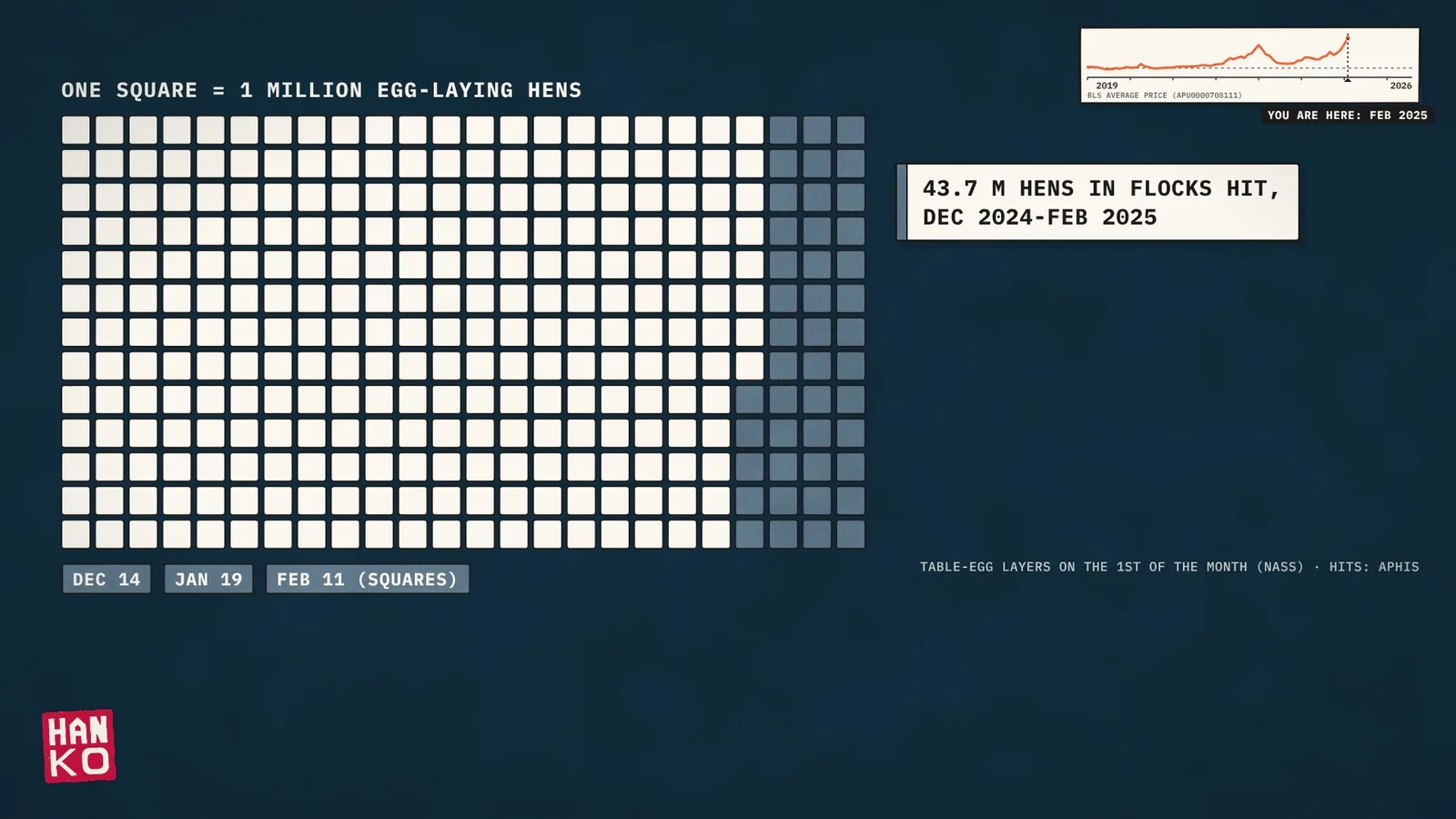
Ohio was hit hardest (14.2 million), then Iowa (6.8 million), Indiana (6.6 million) and California (6.2 million) (USDA APHIS; our math).
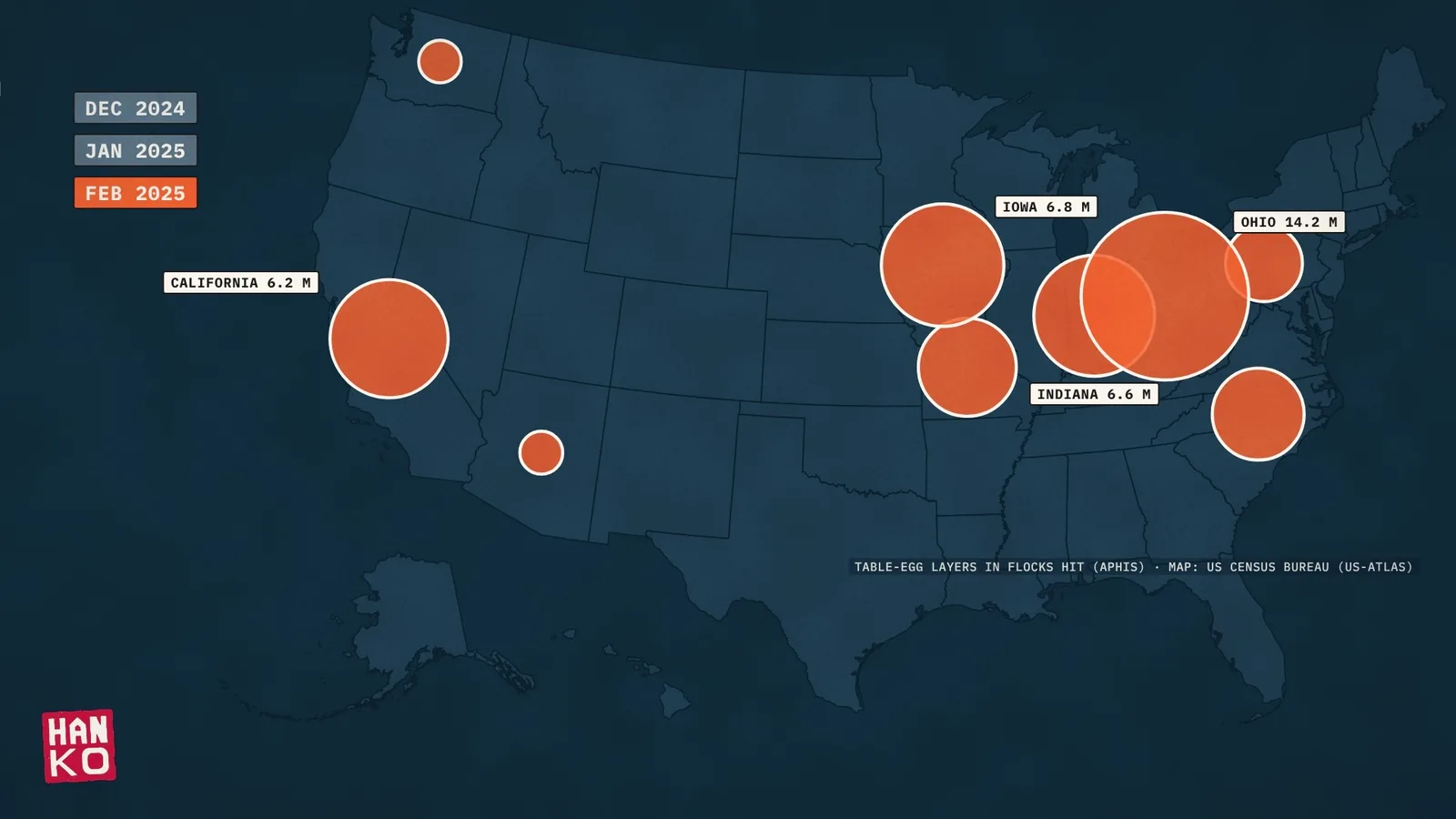
The flock itself fell less, because farms add young hens all the time: by 1 March 2025 it was down 6.5% from December, to 291.9 million (USDA NASS; our math). Refilling takes months. An infected farm must be cleaned out, and young hens are reared for 16 to 17 weeks before moving to a laying house (CRS).
February 2025: the scramble
On 21 February 2025, USDA’s market report said wholesale prices were hitting new highs daily, with spot bids outpacing offers “often by as much as factor of ten” (USDA AMS). That week AMS’s national wholesale price for loose white large eggs passed $8 a dozen ($8.07, as first reported) (USDA AMS).
In Nevada, J.J. Goicoechea, director of the state’s Department of Agriculture, used an emergency power to suspend the state’s cage-free egg law from 20 February 2025. His department said bird flu was hitting “particularly cage-free egg producers.” His reason: “When families can’t find eggs on the shelf, and when they do the prices are not attainable, this can leave them without an essential food they depend on” (Nevada Department of Agriculture).
The order ended on 20 June 2025. Nevada said its prices fell $1.37 a dozen on average (Nevada Department of Agriculture), but the US average fell too, from $5.90 in February to $3.78 in June (BLS). Cage-free eggs cost more to produce, several states require them, and about 45 in 100 US table-egg layers were cage-free in May 2025 (SEC filing; SEC filing). We found no official estimate of how much of the peak cage-free rules explain.
In March the average shelf price peaked at $6.23, the highest since the BLS series began in 1980. Two eggs for breakfast then cost $1.04, against 23 cents in 2019 (BLS; our math).
Wholesale vs the shelf
By then wholesale had already fallen off a cliff. AMS’s national price dropped from $8.07 to $3.00 by 28 March, down 62.8% in five weeks, and on 7 March its report noted that outbreaks “have slowed” (USDA AMS; our math). The shelf price was only just peaking.
Quarter by quarter, New York’s wholesale price averaged $6.75 a dozen in January to March 2025, and the US average shelf price $5.69. They are different markets, but at the height of the scramble, big buyers in New York paid more than the average shopper (USDA ERS; BLS; our math). On the way up, the shelf price rose more slowly than wholesale; on the way down, it fell more slowly too.
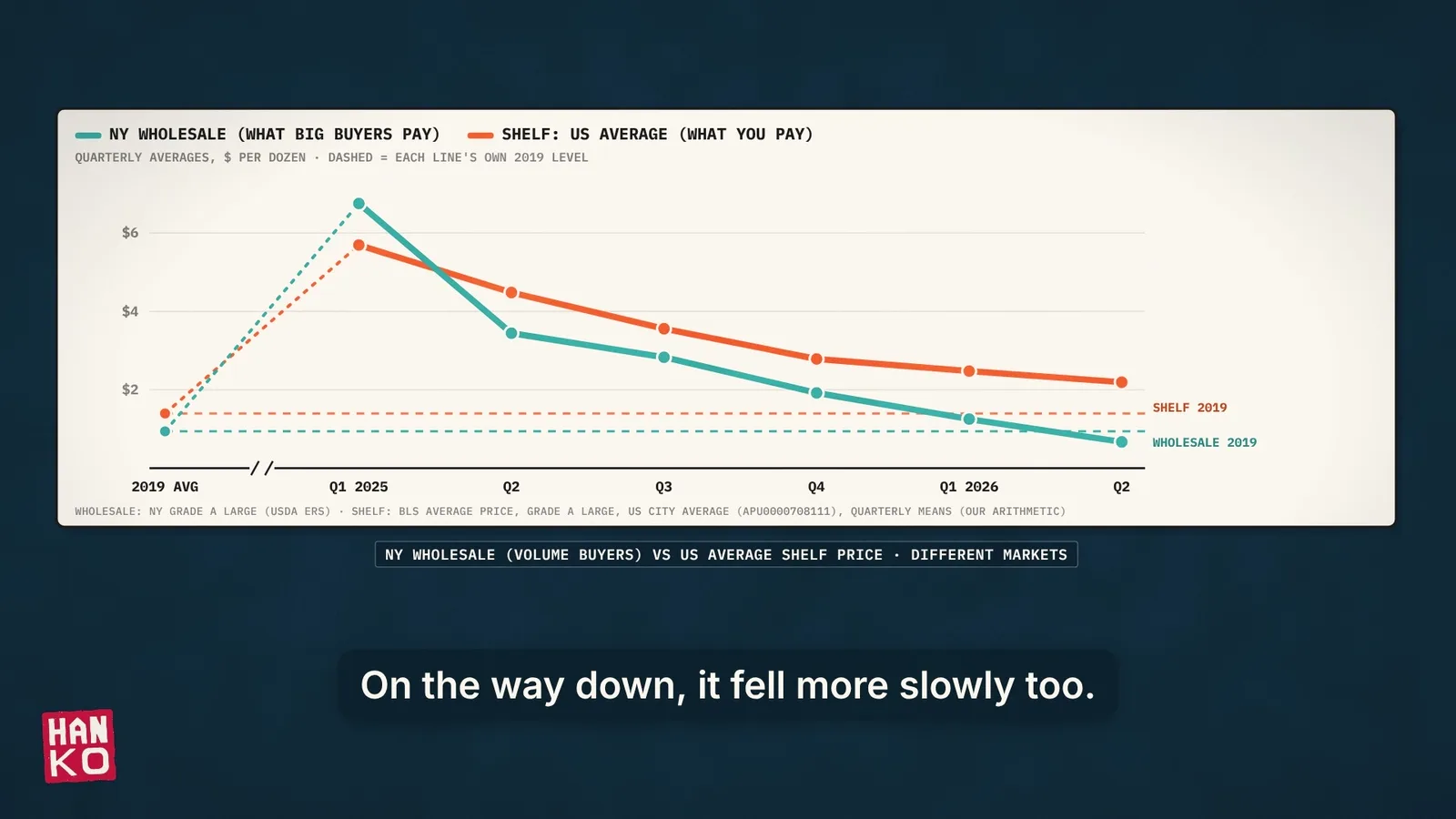
About a year after the peak, in April to June 2026, wholesale averaged 67 cents, below its 2019 level of 94 cents, while the shelf price averaged $2.19, still 57% above its own (USDA ERS; USDA ERS; BLS; our math). USDA’s economists put it this way: “retail prices have fallen as well, usually with a lag from the wholesale price shifts” (USDA ERS). The gap pays for grading, packing, trucking and the store, plus any margin; these numbers cannot split it.
Why the wholesale quote matters
Much of the egg trade is priced off published wholesale quotes: the largest US egg producer says most conventional eggs are sold at prices that take such quotes into account, from a private market-news firm or USDA (SEC filing). When a quote moves, many contract prices move with it.
On 29 June 2026, the Justice Department and 17 states filed a civil complaint in federal court in Iowa, announced on 30 June (US Department of Justice; US Department of Justice). It alleges that three egg producers, Cal-Maine Foods, Hickman’s Egg Ranch and Versova, coordinated their bidding between June 2022 and March 2025 to push up the daily quotations of Urner Barry, a market-reporting firm that takes spot-market bids into account (US Department of Justice; US Department of Justice). Proposed settlements were filed the same day and are subject to court approval, which was pending as of October 2026 (US Department of Justice; Cal-Maine). None of them counts as an admission: the proposed final judgments say they are not an admission by any party, and Cal-Maine says its agreement does not admit wrongdoing (US Department of Justice; Cal-Maine). The complaint gives no estimate of how much prices were affected (US Department of Justice). These are allegations in a civil case, not findings by a court.
Why prices came down
USDA’s economists point to fewer new detections in early 2026 than a year earlier, and enough young replacement hens (USDA ERS). On 1 August 2026 the flock, 315.8 million table-egg layers, was above its 1 December 2024 level and every month since (USDA NASS; USDA NASS). And the largest producer’s annual report says “panic-driven purchasing activity appears to have subsided” (SEC filing).
Bird flu has not gone away. In February 2026 it hit flocks holding 9.5 million laying hens (USDA APHIS). That month the producer price index for eggs nearly doubled from January, but with a bigger flock and more young hens coming through, the shelf price kept falling (BLS; BLS; our math).
Imports quadrupled, from 30.1 million dozen in 2024 to 120.9 million in 2025, yet were only 1.4% of US supply (USDA ERS; our math), and early-2025 imports were “largely destined for the broken-egg market,” for processed food (USDA ERS). Vaccines exist, but USDA said in March 2025 that “the use of any vaccine has not been authorized at this time”; the one conditionally licensed in February 2025 was for H5N2, not the outbreak’s H5N1, and trading partners may refuse vaccinated poultry products (USDA APHIS; CRS). Trade press said a proposal for laying hens was still under review in August 2026 (AgroNews).
In the latest data, for August 2026, the average dozen cost $2.27, almost 19 cents an egg, and it has been roughly flat since April (BLS; our math). After general inflation, it is still about 24.5% above the 2019 average, by our calculation (BLS; our math).
Japan: same virus, a different path
In the same winter as America’s first peak, Japan had its worst bird flu season yet: 84 cases from October 2022 to April 2023, with about 17.71 million birds set for culling (MAFF). On 1 February 2023 its laying hens were down 6.3% on a year earlier (ALIC), roughly the share America lost over its worst three months, 6.5%, though over a different period (USDA NASS; our math).
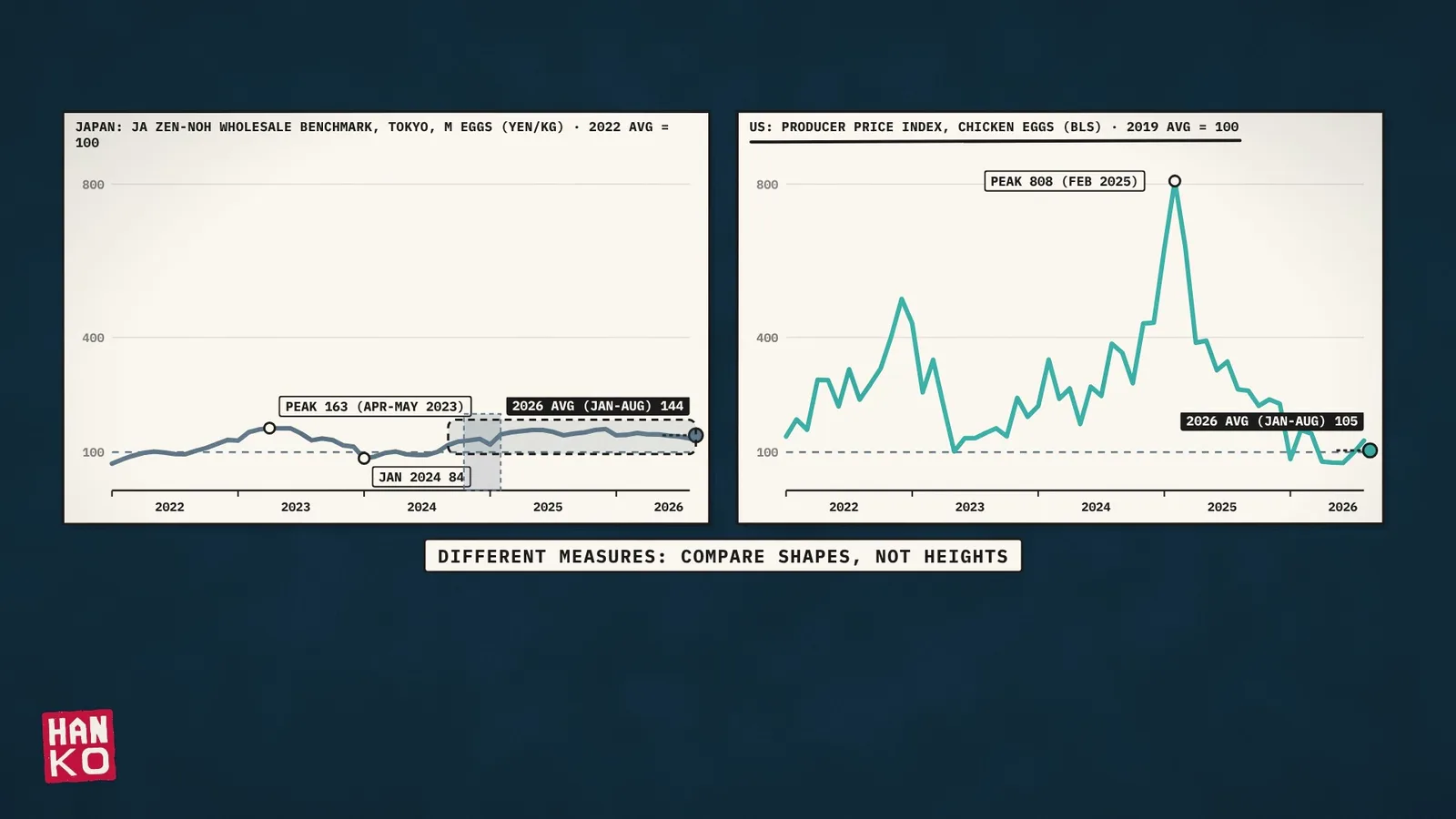
Japan’s JA Zen-Noh Tamago wholesale benchmark for M eggs in Tokyo rose from a 2022 average of ¥215 a kilogram to ¥350 in April and May 2023, about 63% (JA Zen-Noh Tamago; our math). It eased to ¥180 by January 2024, then climbed again in another bad bird flu winter: Japan’s 2024-25 season had 51 cases and more than 9 million birds culled (JA Zen-Noh Tamago; MAFF). The 2025 average, ¥324, was above 2023’s ¥306, and in January to August 2026 the benchmark averaged 144 on a 2022 = 100 scale (JA Zen-Noh Tamago; our math).
America’s producer price index for eggs, a different measure, peaked at 808 on a 2019 = 100 scale in February 2025 and averaged 105 in January to August 2026 (BLS; our math). America’s price shot up and fell back; Japan’s rose less and, the second time, stayed up. Why Japan’s price stuck is beyond this episode’s research.
The answer, and your carton
Bird flu took out hens faster than farms could replace them, and because shoppers could not easily do without eggs, a small gap in supply became a huge jump in price, first at wholesale, then on the shelf, with panic buying adding to the peak (CRS; USDA AMS; SEC filing). When outbreaks slowed and flocks refilled, wholesale collapsed within weeks and the shelf price followed over the next year (USDA AMS; USDA ERS; USDA ERS).
That chain is still in place: when bird flu reaches egg farms, the farm end usually moves first and the shelf price tends to follow, both ways, with a lag (USDA ERS). A dozen eggs is the far end of a pipe that starts with a count of hens. This explains mechanisms, not investment advice.
More Money Mechanics: why Switzerland is so expensive, yet still so rich. For the yen’s long slide, see why Japan got so cheap.