Japan won't open its biggest tomb because, to the imperial family, it is still a grave. The Imperial Household Agency manages the great keyhole-shaped mound in Sakai as the tomb of Emperor Nintoku, rites are still held there, and the government told parliament in 2013 that what matters most at such tombs is keeping them in tranquillity and dignity (Sakai City; House of Representatives). Researchers can apply to enter some imperial tombs, but digging into the mound is another matter (House of Representatives).
That choice keeps the biggest question open: who is inside. Many scholars say the person buried here has not been identified, and they have asked for decades for tombs like this to be more open (Japanese Society for Historical Studies et al.). Meanwhile the tomb has given up clues anyway: a slope that collapsed in 1872, a set of drawings, a small knife that turned up in a museum collection in 2024, and a laser map reported in 2026.
Longer, not bigger
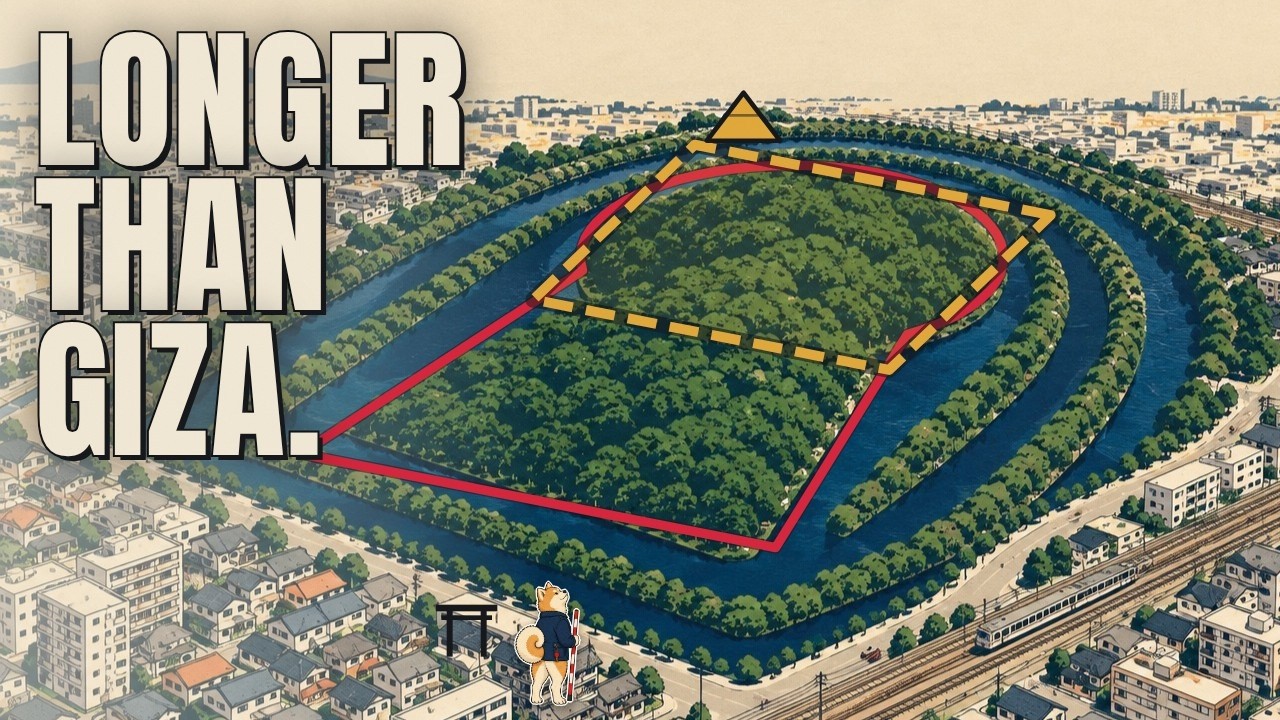
By Sakai City's figures, the mound is about 486 meters long, and 840 meters including its moats (Sakai City Museum; Sakai City). That is more than twice the length of the Great Pyramid of Giza, at 230 meters (nippon.com). But it is not taller. The mound's highest point, on its round end, is about 35.8 meters, against the pyramid's original height of about 146 meters (Sakai City; nippon.com). The Agency for Cultural Affairs gives 34.8 meters (Agency for Cultural Affairs); either way it is about a quarter of the pyramid.
Nor does it hold more. Sakai puts the main part of the mound above the water at about 1,400,000 cubic meters, against 2,600,000 for the Great Pyramid and 3,000,000 for the mound of China's First Emperor (Sakai City). Guinness lists the First Emperor's tomb as the largest tomb of a known individual (Guinness World Records). So "biggest" here means biggest in Japan: Sakai calls it one of the largest tombs in the world, and it is the longest of Japan's ancient burial mounds, called kofun (Sakai City).
More than 200,000 kofun were built in the Japanese archipelago (Sakai City). This one is keyhole-shaped, with a round end about 249 meters across and a square front about 307 meters wide, and it rises in three tiers (Sakai City). The round end alone is wider than the pyramid's 230-meter base. It is also the only giant keyhole tomb ringed by three moats (Agency for Cultural Affairs); the outer moat seen today was dug again in the Meiji era (Sakai City). From above you see the keyhole. From the street you mostly see trees.
How long it took to build
In 1985, a team at the construction company Obayashi tried to work out how the mound could have been built by hand. They allowed only ancient tools, iron-tipped spades and hoes and rope baskets, and assumed eight-hour days with a day off every week. With up to 2,000 workers a day, their estimate was 15 years and 8 months, and about 6.8 million worker-days (Obayashi; Agency for Cultural Affairs). In their plan, about half of the earth came from digging the moats and the rest was carried in, and stones to cover the slopes came by raft from the nearby Ishizu River (Obayashi).
The tiers were then lined with clay cylinders called haniwa. The Agency for Cultural Affairs estimates that more than 29,000 cylindrical haniwa were set up (Agency for Cultural Affairs). All of it is an estimate, not a record.
Who is inside
Officially, the Imperial Household Agency manages the mound as the tomb of Emperor Nintoku (Sakai City). He appears in Japan's oldest chronicles, from the eighth century. In one legend in the Nihon Shoki, he excused his people from taxes and labor and was praised as a sage ruler (JapanKnowledge); the well-known telling has him seeing no cooking smoke rising from their homes. Sakai City links this group of giant tombs to the fifth-century age of the "five kings of Wa" recorded in Chinese histories (Sakai City).
Archaeologists read the ground instead. By its style the mound dates to the fifth century; sources differ on exactly when (Agency for Cultural Affairs). And Sakai's archaeologists say it was built after the nearby tomb that Japan assigns to Emperor Richū, who in the chronicles is Nintoku's son (Sakai City). The son's tomb is older than the father's. That does not prove who is buried here, but in 2018 a group of 13 academic societies said in writing that the person buried in these tombs has not been identified by scholarship, and that a specific name could lead to misunderstanding (Japanese Society for Historical Studies et al.). That is why the mound is also called Daisen Kofun, after the place.
The tomb holds at least two stone chambers. Sakai City's historians think the main burial is a large stone coffin at the center of the round end; the other chamber is in the square front, and who was buried there is also unknown (Sakai City). No modern excavation has reached either.
Why it stays shut
In a 2013 written answer about this tomb, the government described imperial tombs as places where emperors and members of the imperial family are buried, and said that keeping them in tranquillity and dignity matters most. It said it would continue building an office in the grounds whose work is linked to imperial rites at the tomb, and that a steel fence is there to keep outsiders from entering (House of Representatives). A 2010 answer said the agency's management puts tranquillity and dignity first, that it studies the tombs itself, taking the various theories into account, and that academic researchers can be given permission to enter (House of Representatives).
The closest a visitor can get is a small worship area at the front, across the moat. In 1888, the office then in charge of imperial tombs drew up a new design for it, with stone gates, a torii and lanterns (Sakai City). A path of about 2.8 km runs around the outside (nippon.com). What you see is water, a fence and a forest.
The water has its own history. In 1894, the heads of two villages asked the imperial household to restore the third moat. On paper, the reason was to guard the tomb; Sakai's historians think the villagers also hoped to use the water for farming (Sakai City).
In 2019, the tomb became part of the Mozu-Furuichi Kofun Group World Heritage Site, with 49 kofun in the region (Agency for Cultural Affairs; UNESCO). Scholars push the other way. Since the 1970s, academic groups have asked for imperial tombs to be more open, and in 2018 they asked that sites like this be used on the principle of openness, and worried that a name like "Emperor Nintoku's tomb" makes the question of who is buried there sound settled (Japanese Society for Historical Studies et al.).
The agency has dug here, but not into the mound. Starting in 2018, with Sakai City's help, it opened test trenches on the first embankment, beyond the inner moat, and an agency researcher later presented the results at a public lecture in Sakai in February 2023 (Sakai City; nippon.com).
The 1872 collapse
In 1872, part of the slope on the front of the mound gave way, and a stone chamber and a long stone coffin were exposed, along with gilt-bronze armor, glass vessels and swords (Bungeishunju). The local governor reported it to the ministry in charge of religion and asked to survey it. Within two weeks the ministry sent word, and the man who went was Kashiwagi Kaichirō (1841–1898), a skilled artist and a keen collector of old things (Bungeishunju; Kansai University).
Kashiwagi drew the chamber from above and the coffin from the side. One plan's title says the coffin was revealed when the ground slipped. The curator Uchikawa Takashi of Kokugakuin University, who studies him, wrote that the drawings show no ordinary skill (Bungeishunju). The coffin is one of the largest stone coffins in Japan (Agency for Cultural Affairs). The armor lay on one side of it and about 20 iron swords on the other, and there were two glass vessels, a jar and a white dish (Sakai City). The Agency for Cultural Affairs says the glass is thought to have come from West Asia, and Sakai City compares it with a glass set from a tomb in Nara (Agency for Cultural Affairs; Sakai City). His armor drawing shows a brimmed helmet of small riveted plates, all of it gilded (Bungeishunju; Sakai City).
Then everything went back. The objects were returned to the chamber, and the chamber and coffin were buried again. The coffin's lid was never opened, so what is inside is still unknown (Agency for Cultural Affairs; Sakai City). For more than a century and a half, these objects were known only from drawings (Kansai University).
What came back
In 2024, a copy of the armor drawing, kept in the Imperial Household Agency's archives, went on show in Sakai (Sakai City). That same year, Kokugakuin University Museum in Tokyo acquired a collection that included a small knife in a gilt-bronze sheath and pieces of armor. The knife's paper wrapping says, in ink, that it was found in 1872 (Sakai City Museum; Sakai City). The material had been kept by Kashiwagi and reached the museum through art dealers; the sources do not say how it came to be in his hands, and we do not guess (Kansai University).
In June 2025, checking with Sakai City confirmed that the pieces had come from the tomb; Sakai describes them as thought to be connected with the 1872 chamber and coffin (Kansai University; Sakai City). From July 19 to September 7, 2025, they were shown at the Sakai City Museum, the first time grave goods from this tomb had been displayed anywhere in Japan (Sakai City; Kyodo News PR Wire).
A map made with light
In May 2026, Kyodo News reported that a laser survey map of the mound shows three step-like slopes and flat surfaces near the top of the square front, possibly a square platform of piled earth. Some keyhole tombs have another burial in the front, so an unknown burial may remain, but the trees are thick and checking on the ground is hard (Kyodo News via Akita Sakigake Shimpo). This is a news report; nothing has been confirmed.
So the mound stays quiet. To the agency, that is respect for a grave still in use. To many scholars, it is a locked archive. Under the front slope, the coffin Kashiwagi drew is still there, its lid still closed.
For the previous episode in this series, see How the Black Death Crossed Europe, Month by Month.