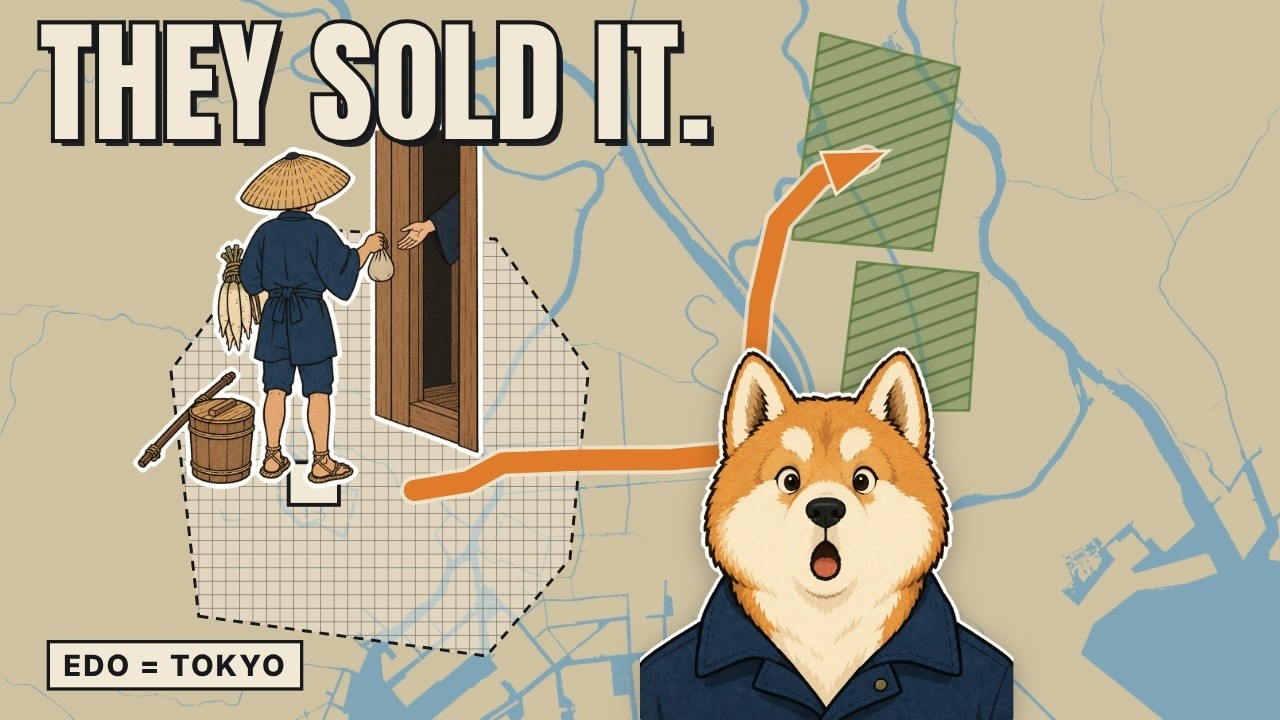
Farmers paid for the waste of Edo, today's Tokyo, because it was fertilizer. In a city of about a million people in the 1700s, a household's waste belonged to its landlord, who sold the right to empty the privy to farmers from the villages around the city; they paid in cash or in vegetables, carried the waste out by boat and spread it on their fields (Kotobank; Hanley; Howell). In 1831 the novelist Kyokutei Bakin recorded the usual payment from the man who emptied his privy: three hundred dried radishes (Kreitman).
The trade lasted as long as the waste was worth money. In 1918 Tokyo's collectors stopped paying and began charging instead, and after the Second World War chemical fertilizer and sewers ended the system (Kreitman).
Who owned it
Edo's commoners alone numbered about 350,000 in 1695 and 500,000 in 1721. Adding a samurai population thought to be about as large gives an estimate of about a million, one of the largest cities in the world at the time (Kotobank). Surveys from 1734 to 1867 never counted fewer than 500,000 commoners (Hanley).
A farmer could not simply take the waste. Suppose you rented a room in a nagaya, one of Edo's long row houses: your landlord could sell your household's waste to a farmer, a village or a dealer, and one historian found cases where the privy earned a landlord more than the rent (Howell). In Osaka the rights were even split: the landlord owned the solid waste, which was worth more, and the tenants owned the urine (Hanley).
Not all waste was worth the same. Collectors paid a premium for the waste of lords' mansions, believing the waste of the well-fed was richer (Howell). In 1742 a farmer named Hanbei, from the village of Tanashi, won the rights to the mansion of the Hitotsubashi, relatives of the shogun. His price was 1,500 large radishes, or 2,000 medium ones, or two ryō in cash, paid at the end of the year, with the choice left to him; the rights went out to bid again every year (Hanley). The season mattered too: the price was highest in spring, when farms were busiest, and lowest in summer (Katsushika City).
Much of the city's urine simply soaked into the ground, because there were few urinals. In 1784 villages asked to place urine buckets in Edo's streets; officials refused, partly because the buckets would block traffic (Howell).
The trip out of the city
We do not know the route Bakin's collector, Isaemon, took. A typical trip ran from the privy to a landing on the water, because Edo was a city of canals and rivers. East of the city, in Kasai, a district of rice paddies that also shipped vegetables to Edo, wealthy farmers ran the boats as a side business, and people called them Kasai boats (Katsushika City). There were many landings along the Naka and Edo rivers where night soil was unloaded (Katsushika City). Some loads were carried upstream as far as about 40 km from the city (Howell).
The rivers were busy with this cargo. In 1872, by one count, 1,564 of the 6,545 boats registered in Tokyo, about one in four, were night-soil boats (Howell). Waste went out, vegetables came back in, and money moved along the loop: the city got rid of its waste, the farms got fertilizer and the landlords got paid.
The price fight
Prices kept climbing. By the late 1780s farmers complained that the cost of collection had risen to nearly three or four times what it had been in the 1740s. That is the farmers' claim, not a measured rise (Wikipedia).
In November 1789 villages around Edo petitioned the shogun's finance magistrates for lower prices, with districts choosing representatives to speak for their villages. At its peak the movement had 1,016 villages behind it (Kumazawa; Suda). In 1792 the shogunate ruled: it did not allow the villages to fix prices among themselves, and it barred townspeople from brokering the contracts. It also told landlords not to raise prices without good reason, and prices came down (Kumazawa; Suda). One historian reads the shogunate's role as holding prices down for farmers; urban sanitation was not the aim (Kreitman).
The win did not last. Records from the village of Mabashi show that a boatload cost from about 3 bu to 1 ryō after the 1790s, but from about 1837 it rose to between 1 ryō 3 bu and 2 ryō 2 bu (Suda). In 1843, 283 villages in eight districts of Musashi and Shimōsa petitioned again (Suda). Between 1789 and 1867 there were at least four major disputes (Howell).
London: the money ran the other way
London had night-soil men too, who emptied cesspits and carted the waste to farms outside the city, but there the household paid. By about 1856 the city had some 200,000 cesspits (Wikipedia). Cheap imported guano, seabird droppings, cut sales of cesspit waste as fertilizer (Johnson), and flush toilets sent the waste of wealthier homes straight into the Thames (London Museum).
In the hot summer of 1858 the river's smell became the Great Stink. Parliament, beside the river, hung curtains soaked in chloride of lime, and on 2 August 1858 a bill to fund new sewers became law (London Museum; Wikipedia). Joseph Bazalgette's system, with 82 miles of main sewers and 1,100 miles of street sewers built from 318 million bricks, opened in 1865 and was completed in 1875 (London Museum).
Was Edo cleaner?
The historian Susan Hanley argues that "the level of sanitation was higher in Japanese cities than in Western ones during the same period," because Edo's waste went to farms instead of into its rivers (Hanley). David Howell calls the environmental and hygienic benefit "entirely fortuitous," warns that "one shouldn't equate green results with green intentions," and notes that being cleaner than 18th-century London "isn't necessarily very clean at all"; rubbish was often simply thrown over a wall (Howell). Another historian describes the city's sanitation as a "largely inadvertent side effect" (Kreitman).
The system was no shield against disease. London had suffered cholera again and again in the decades before the Great Stink (Wikipedia), and in 1858, the same year, cholera spread across Japan and through Edo (Tokyo Metropolitan Library). Estimates of Edo's death toll vary widely, so we do not give one.
The flip
A national cleaning law of 1900 left human waste out of the city's duties, because landlords still saw it as a resource (Kreitman). Then in 1918 collectors across Tokyo refused to buy waste from landlords or to collect it, and privies began to overflow. The collectors asked the police for permission to charge residents, and more than a year later they got it. Waste had gone from a product to rubbish (Kreitman; Howell). Now, as in London, the household paid.
An amended law in 1930 made disposal the city's job, with a deadline in Tokyo of 1 November 1934. In 1935 the city's cleaning department bought a ship to dump surplus waste in Tokyo Bay, and during the war trains carried it out to farms (Kreitman). The old system had a cost: a 1948 estimate found that 80% of Japanese people had intestinal parasites. The occupation authorities set up hydroponic farms so their people could avoid vegetables grown with night soil, and by 1949 nitrogen fertilizer production had passed its prewar peak, while the price of night soil fell from 1948 (Kreitman).
Sewers came slowly. In 1956 just under one in five Tokyo homes had sewer service; by the 1964 Olympics most of the old city was connected (Kreitman). Night-soil boats in Katsushika kept running into the early 1960s (Katsushika City). Sewers in Tokyo's 23 wards reached essentially 100% coverage by the end of fiscal 1994 (Tokyo Metropolitan Government), and in March 2018 80.2% of households of two or more people had a toilet seat with a warm-water wash (nippon.com).
So farmers paid for Edo's waste because it grew their food, and the trade lasted only as long as it paid. If Edo's rivers were cleaner than London's, that was a side effect.