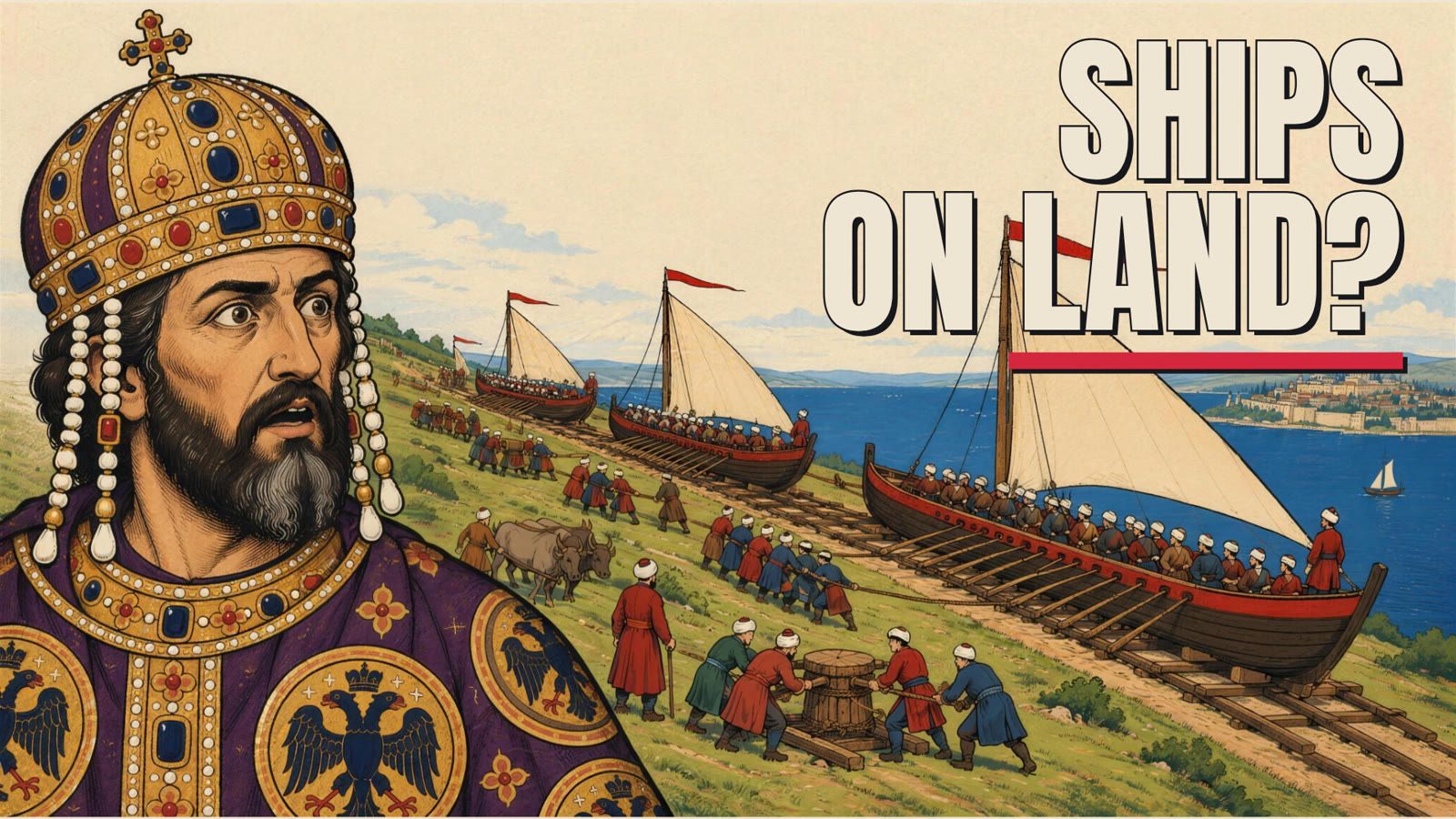
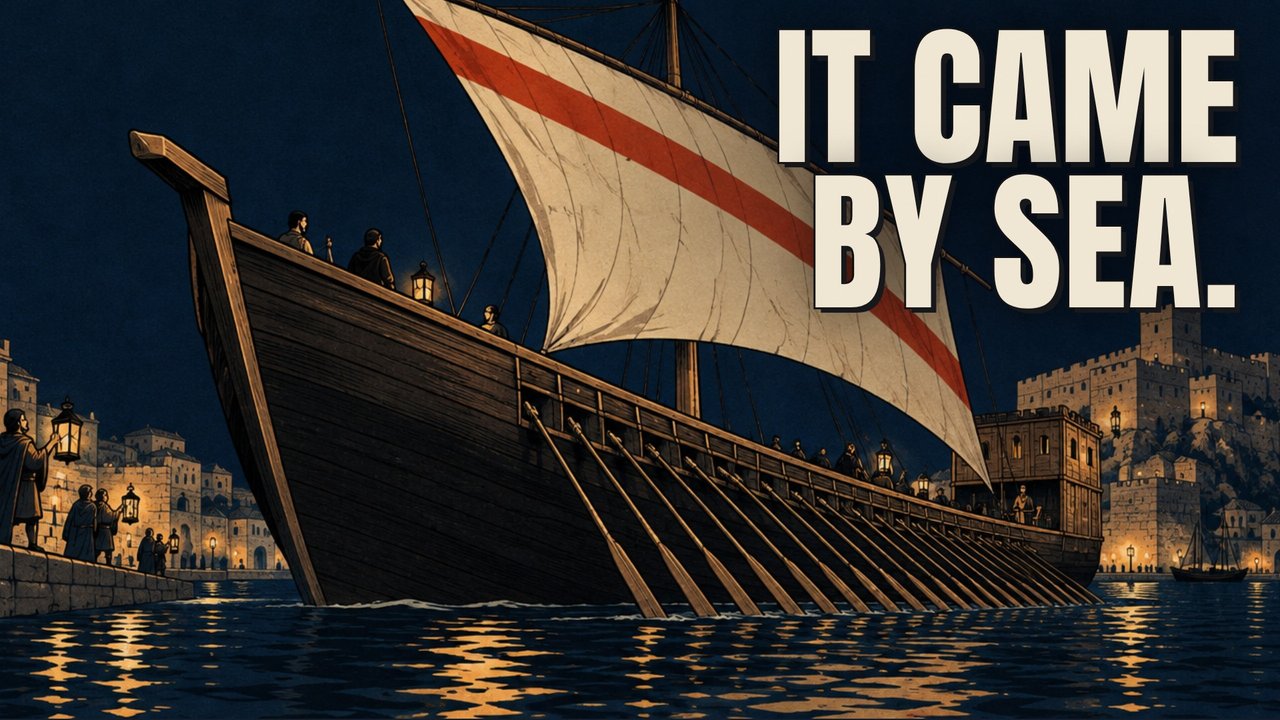
The Black Death crossed Europe in about six years. It was inside Constantinople by early May 1347, was raging in Messina, Sicily, that October, and reached Moscow in 1353 (History Today; Cesana et al.). It traveled first by sea, at around 40 km a day in the estimate of the plague historian Ole Benedictow, and then overland at up to about 2 km a day (History Today), so it held the big ports months before it reached the towns between them.
It killed somewhere between about a third and well over half of the people, depending on the region and on whose estimate you use (Medievalists.net; History Today). And nobody living through it knew what was carrying it.
A friar’s blank parchment
Two years in, a Franciscan friar in Kilkenny, Ireland, was writing down what he saw. His name was John Clyn. At the end of his annals he left blank parchment for anyone still alive to carry on: “I leave parchment for continuing the work,” he wrote, “if haply any man survive, and any of the race of Adam escape this pestilence” (CELT). We will come back to those pages at the end.
Origin: gravestones near Lake Issyk-Kul
For centuries, the plague’s starting point was a blank on the map, somewhere in the East. The answer came in 2022, from two medieval cemeteries, Kara-Djigach and Burana, near Lake Issyk-Kul in what is now Kyrgyzstan. Their gravestones show an unusual spike in burials in 1338 and 1339, and some inscriptions name the cause as pestilence (Spyrou et al.; University of Stirling).
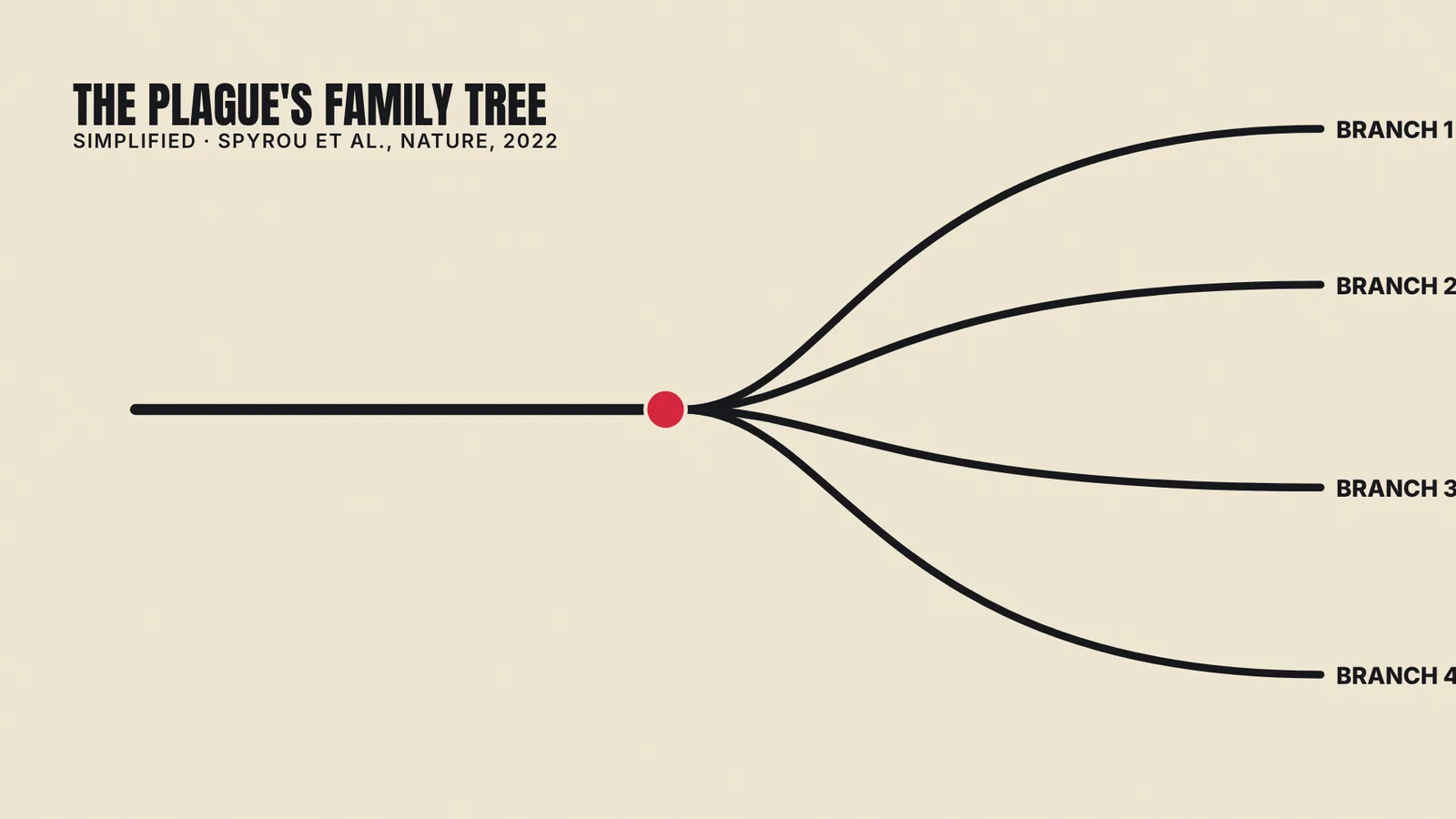
The team recovered ancient DNA from seven people buried there. Two plague genomes could be rebuilt, and both were the same strain. It sits right at the point where the main branches of the plague that still exist today split apart, and the paper calls it their “direct progenitor” (Spyrou et al.). Comparisons with plague in the wider Tian Shan region today support a local emergence of the strain.
What the DNA cannot show is the road the plague took next. The next time it appears in the records, eight years later, it is far to the west: in the lands of the Golden Horde on the lower Volga, in April 1346 (Cesana et al.). From there it was a short way to the Black Sea, and to Caffa, a walled Genoese trading town in Crimea.
Caffa: a famous story, debated
The best-known story about the Black Death says that an army besieging Caffa hurled its own plague dead over the walls. It comes from Gabriele de’ Mussi, a notary in Piacenza, who wrote it down from what others told him; he does not claim to have seen it (Wheelis). One researcher who studied the account in 2002 judged the attack plausible but unlikely to have played a decisive role in the plague’s spread to Europe (Wheelis). Others argue it probably never happened: the chronicler was far away, and the Mongol army’s likely siege engines could hardly have thrown bodies over the walls (Bulletin of the Atomic Scientists).
The historian Hannah Barker found that the timing does not fit either. Caffa was besieged twice, and the plague struck the town after the second siege was lifted (Barker; Medievalists.net).
Grain ships, not a siege
Barker points to something ordinary instead: grain. In 1346, Venice and Genoa and the Golden Horde kept embargoes on each other, and trade was effectively cut off. Only when peace returned and the 1347 grain harvest was shipped did the plague cross the Black Sea, in her words “an unintended consequence of peace” (Medievalists.net; Barker). A 2017 study also reads the almost simultaneous outbreaks in Tuscan towns as a sign that the plague moved with shipments of grain and flour (Cesana et al.).
Constantinople and the sea lanes
The first great city in the ships’ path was Constantinople. By early May 1347 the plague was inside the walls, and Andronikos, the youngest son of Emperor John VI Kantakouzenos, died in the first days (History Today; Cesana et al.).
From there the sea lanes fanned out. Venetian galleys called at Crete in 1347; the plague reached Alexandria around the start of September and Genoa in the late summer (Cesana et al.; History Today). From Alexandria it spread through Egypt into Syria, and Damascus was hit by the summer of 1348 (Wikipedia). By the end of 1347 it held a string of ports from Constantinople to Marseille, while much of the land behind them had not yet been touched (History Today; Cesana et al.).
The silent weeks
A ship could unload and leave, and for weeks no one would notice anything wrong. Historians estimate it took about five and a half to six weeks before a village realized it had an outbreak, six or seven weeks for a town, and seven for a city (Cesana et al.).
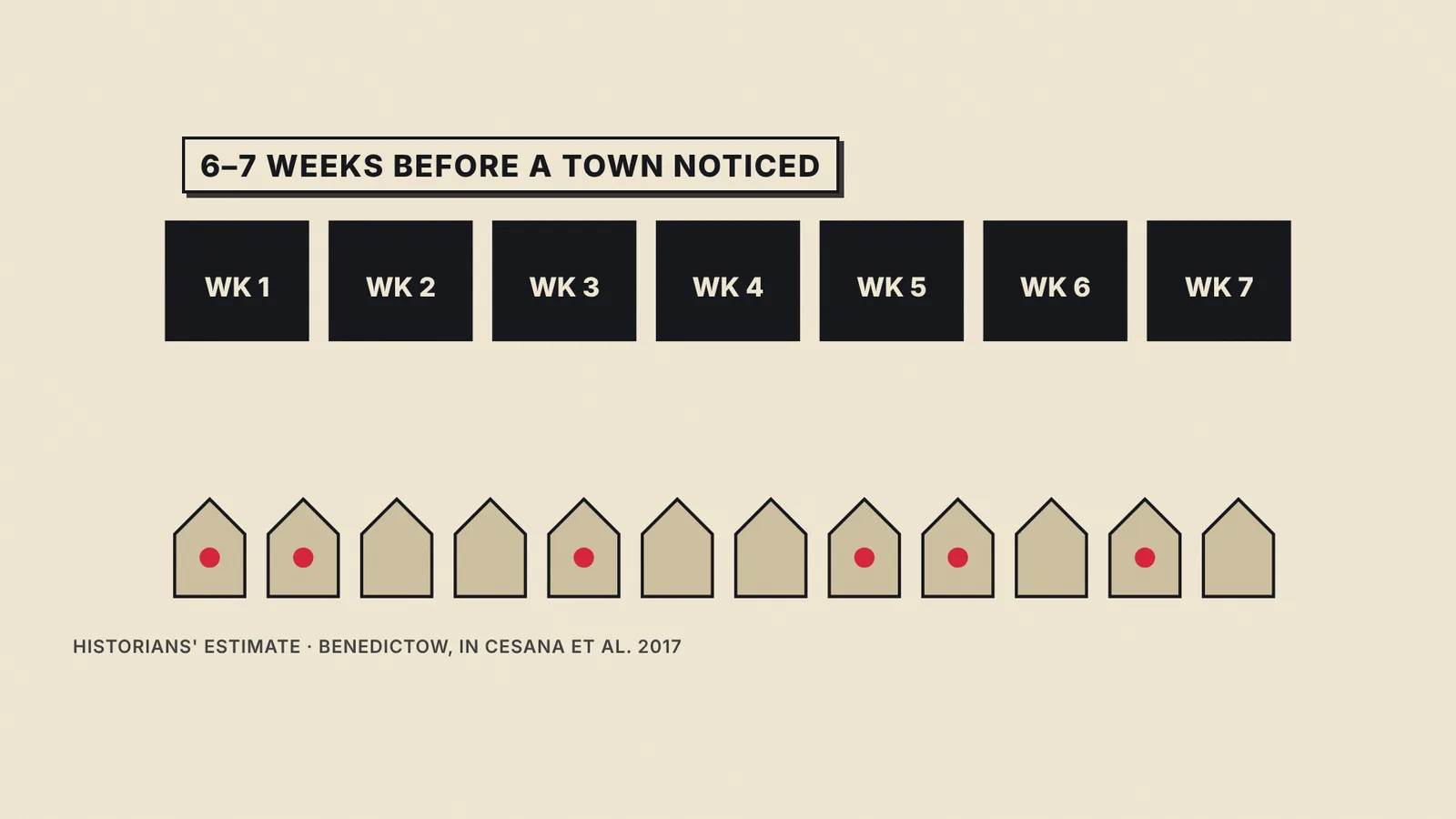
Venice shows the gap clearly. The plague probably came in with the returning fleet in mid-November 1347, but the city did not recognize it until late March 1348 (Cesana et al.). That is why old chronicles and modern studies often disagree about dates.
Messina is the classic case. A Sicilian chronicle, traditionally credited to Michele da Piazza, though its author is in fact anonymous and was probably from Catania (Treccani), says Genoese galleys came into the harbor at the beginning of October 1347. “In their bones they bore so virulent a disease that anyone who only spoke to them was seized by a mortal illness” (Historia Sicula). The 2017 study, following Benedictow, puts the ships’ arrival months earlier, in the second half of June (Cesana et al.). Either way, by October, Messina knew.
Ships were about 20 times faster than roads
By ship, Benedictow estimates, the plague traveled around 40 km a day, enough to move 600 km along a coast in a fortnight. On land it was much slower: up to about 2 km a day on the busiest roads, and about 0.6 km a day on smaller ones (History Today). By our calculation, that makes the ships about 20 times faster than the best roads (our math).
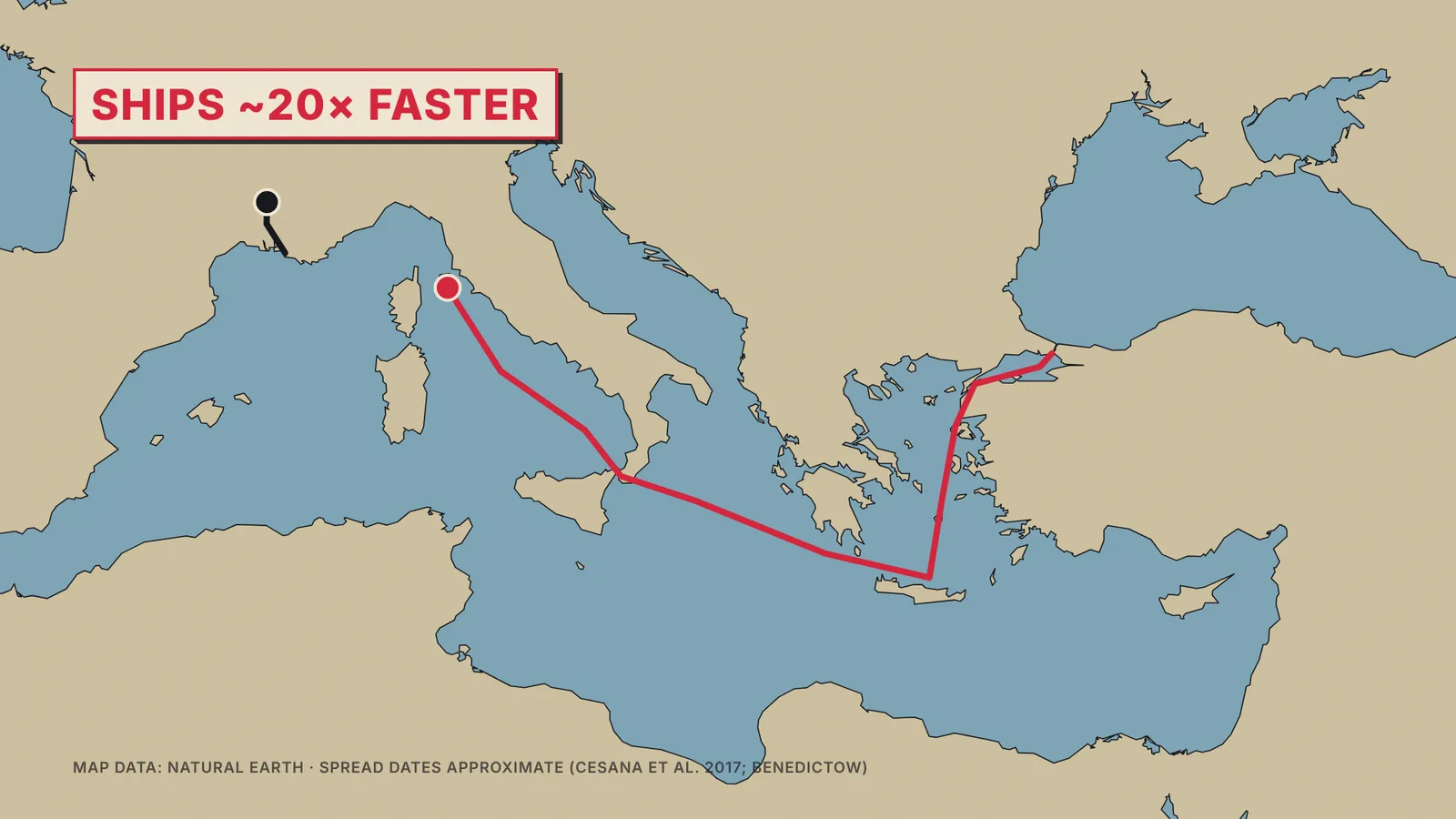
Ships were close to an ideal carrier: crowded, quick, loaded with grain and always bound for the next big port. But a ship can only reach the coast. To get inland, the plague had to walk.
Italy: trade, not distance
Florence, one of the richest cities in Europe, was struck in March 1348 (Cesana et al.). Bologna, about 110 km away, was hit within the same month, and Modena, about 160 km away, too. Siena, only about 70 km away, took almost two months, according to one study of the Italian records (Medievalists.net). Distance did not decide it. Trade did: the plague followed the busiest routes, not the shortest ones.
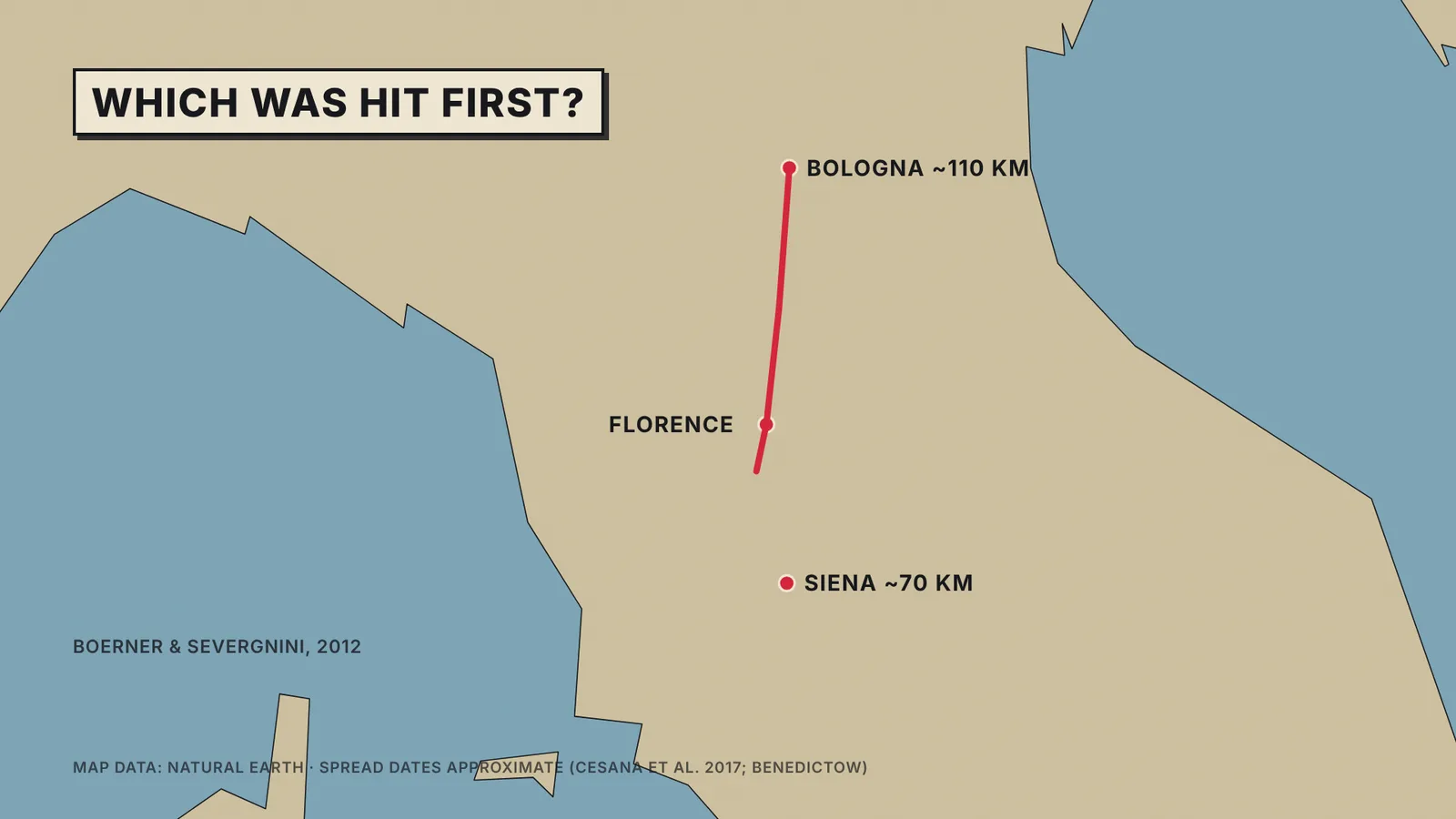
In Florence, within a few months, about 60% of the people died (History Today; Cesana et al.). The writer Giovanni Boccaccio lived through it and wrote that “fathers and mothers refused to visit or tend their very children” (Boccaccio). He also wrote that more than 100,000 people died inside the walls. That is more than the whole city probably had: around 1338, the chronicler Giovanni Villani estimated Florence’s population at about 90,000, from how much bread it ate (Villani). Boccaccio’s number is an exaggeration; the scale of the loss was not (Decameron Web).
Siena’s turn still came. There, Agnolo di Tura wrote that families abandoned one another, “for this illness seemed to strike through breath and sight” (Wikipedia; World History Commons). And he wrote: “I buried my five children with my own hands” (Wikipedia; translation note).
The toll differed from town to town. Prato lost about 42.5 to 45% of its people; San Gimignano lost about two thirds (Cesana et al.).
France, England and Ireland
In France, the plague climbed north from the southern ports: Lyon by spring 1348, Rouen and the Paris region by early summer (History Today; Wikipedia). A little before midsummer, the Feast of St. John the Baptist on June 24, 1348, it broke out in England, at Melcombe, a small port in Dorset (Wikipedia).
That September, Joan, the young daughter of King Edward III, died of plague near Bordeaux on her way to marry Pedro, the heir to the throne of Castile (Westminster Abbey; Wikipedia). In a letter to Pedro’s father, Edward wrote of “the sting of this bitter grief” (Wikipedia).
The same year it crossed the Irish Sea. Clyn recorded that it began near Dublin, at Howth, Dalkey and Drogheda (CELT).
Rats or people: still open
For a long time, the textbook answer to what carried it was rats and their fleas. In 2018, a team modelled nine plague outbreaks in Europe between 1348 and 1813; only one, in the French village of Givry, was from 1348. In seven of the nine, spread by human fleas and lice matched the death records better than spread by rats (Dean et al.).
Other experts pushed back hard. Benedictow argued that such models do not suit plague, and that if lice were the main carriers, outbreaks should have grown in cold winters, when in fact plague fades (Benedictow). The 2017 Tuscany study argues that only rats and their fleas, moving with the grain trade, explain what happened there (Cesana et al.). The question is still open.
The beaked mask came three centuries later
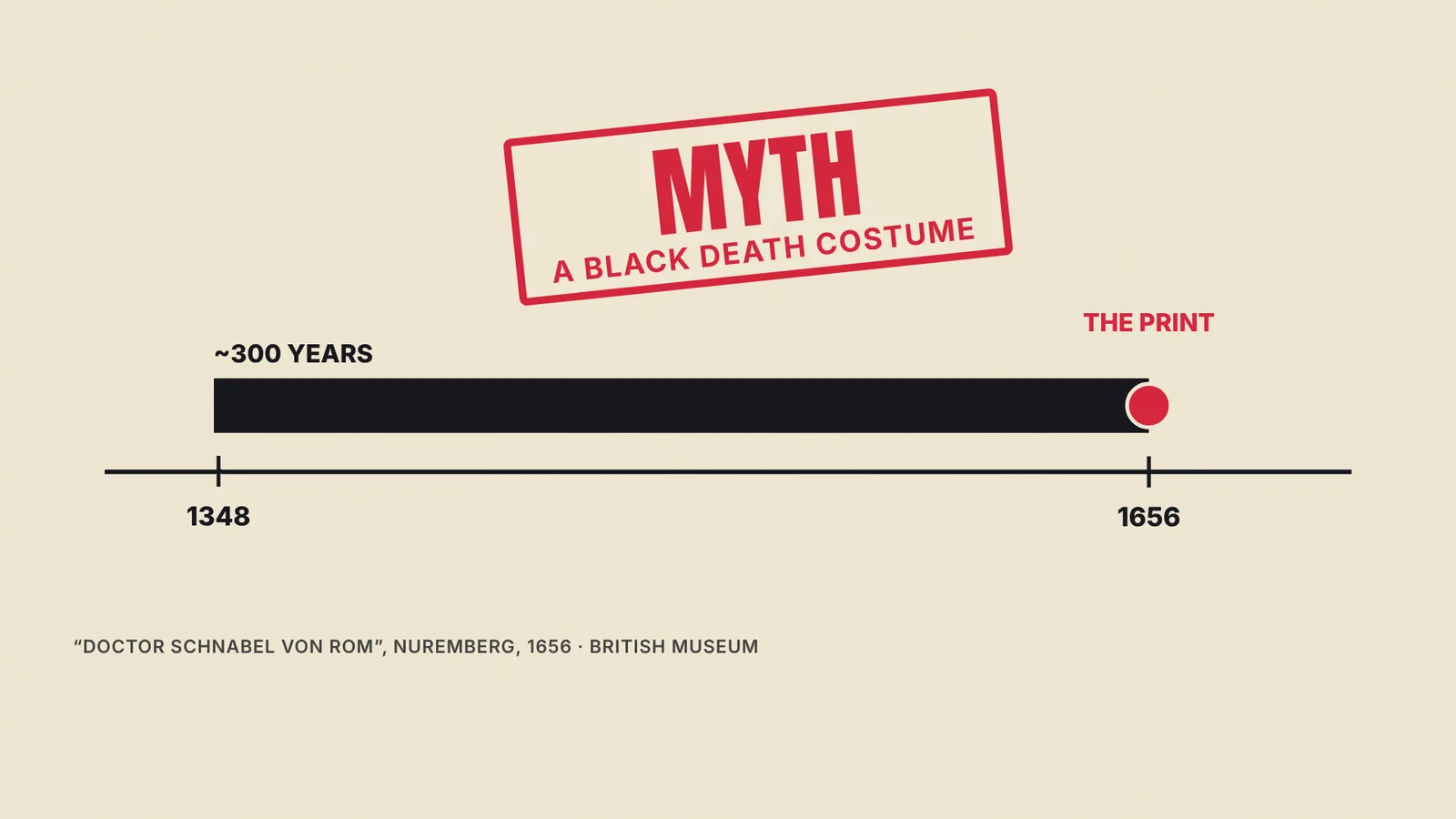
The beaked plague doctor is the best-known image of the Black Death, but there is no evidence that anyone wore that costume in the 1340s (Wikipedia). The most famous picture of it, “Doctor Schnabel von Rom,” is a print published by Paulus Fürst in Nuremberg in 1656, after an Italian sheet, showing a plague doctor in Rome, about three centuries later (British Museum).
By the end of 1348, the plague held most of Italy and France, southern England and the coast of Ireland (History Today; Cesana et al.).
North to Bergen, east to Moscow
By Lent 1349 it was raging in Kilkenny (CELT; our math). Clyn described himself as “waiting among the dead for death to come” (Wikipedia).
That summer, a ship from England brought it to Bergen, in Norway (History Today; Wikipedia). Later stories say the ship drifted in with its whole crew already dead; that part is probably a legend (Wikipedia). It reached Prussia in August 1349, crossed into Russian territory in late 1351 and reached Novgorod in 1352 (History Today). In 1353 it reached Moscow, where Grand Prince Simeon died along with two of his sons and a brother (History Today; Wikipedia).
The places with no record
Iceland has no record of plague in 1346 to 1353; its first recorded outbreak came in 1402 to 1404, about 50 years later (Medievalists.net). Whether parts of Poland truly escaped is still argued over: one historian finds no sign of a crisis in papal levy, court or pollen records, while Benedictow disagrees (Guzowski).
Far to the east, there is no record of the Black Death reaching Japan. One historian, Ann Bowman Jannetta, suggests a reason that fits the grain story: Japan did not trade grain with other countries, which may have kept carriers out (Yoshabunko). Japan had troubles of its own. Two rival imperial courts, in Kyoto and Yoshino, divided power from 1336 until 1392 (Britannica), and from 1350 to 1352 the shogun Ashikaga Takauji was at war with his own brother, Tadayoshi (Wikipedia).
Fear and blame
In Europe, fear went looking for someone to blame. By the autumn of 1348, Jews were being accused of poisoning wells, and “confessions” were extracted under torture (Fordham University). In July and September 1348, Pope Clement VI issued bulls calling the charge false, pointing out that Jews were dying of the plague too (Wikipedia).
It made little difference. In 1349, Jewish communities in Basel, Strasbourg, Mainz, Cologne and many other towns were massacred or driven out (Wikipedia). In Strasbourg, the chronicler Jacob von Königshofen wrote that “about two thousand” were killed in a single day, February 14, 1349; some modern estimates are lower (Fordham University; Wikipedia). Across Europe, hundreds of communities were destroyed. One study counts 363 towns with Jewish communities in its data and finds that about half of them saw their Jews killed or expelled (VoxEU (CEPR)).
Others turned on themselves. Bands of flagellants marched from town to town, whipping their own backs in public. On October 20, 1349, the same pope condemned the movement and banned their processions (Catholic Encyclopedia).
How many died: no single number
For decades the classic answer was about one European in three, from Philip Ziegler in 1969, who said himself that it could never be proved. John Aberth puts it at about half. Benedictow, working from careful counts in towns and on estates, puts it at about 60%, and later 65% (Medievalists.net; History Today).
In 2022, a different kind of evidence came in: pollen. Researchers analyzed 1,634 samples from 261 sites in 19 countries to see where farming collapsed. In Scandinavia, France, southwestern Germany, Greece and central Italy, it fell sharply. In much of central and eastern Europe, Ireland and Iberia, farming carried on or even grew (University of Reading). That measures fields, not deaths, but it points the same way: there is no single number. It depended on where you lived.
Fewer workers, higher wages
The survivors faced a new problem: there were not enough workers, and wages rose. With Parliament unable to meet because of the plague (The National Archives), England issued the Ordinance of Labourers in June 1349, ordering workers back to the pay of the years just before (Fordham University). In 1351 the Statute of Labourers set hard caps: a master carpenter could take three pence a day, other carpenters two (Fordham University). Historians say the laws did little to hold wages down, and resentment of their enforcement helped feed the revolt of 1381 (Wikipedia).
“Here, it seems, the author died”
So the Black Death sailed first and walked second. Ships carried it from port to port in months; roads carried it inland, slower but just as surely. It did not need a siege to reach Europe. It needed the grain ships to sail again, and from there it followed the routes people used most.
Clyn’s own manuscript is lost. His words survive only in copies made in the 1600s, about three centuries later, now in Trinity College Dublin, the British Library and the Bodleian (CELT). In those copies, right after his last entry, a later copyist added one line in Latin: “Here, it seems, the author died” (CELT). He had left that parchment for anyone still alive to carry on. People kept copying his pages for centuries, and that is why his account can still be read. “If haply any man survive.” Someone did.
For the previous episode in this series, see The 53 Days That Ended the Roman Empire.