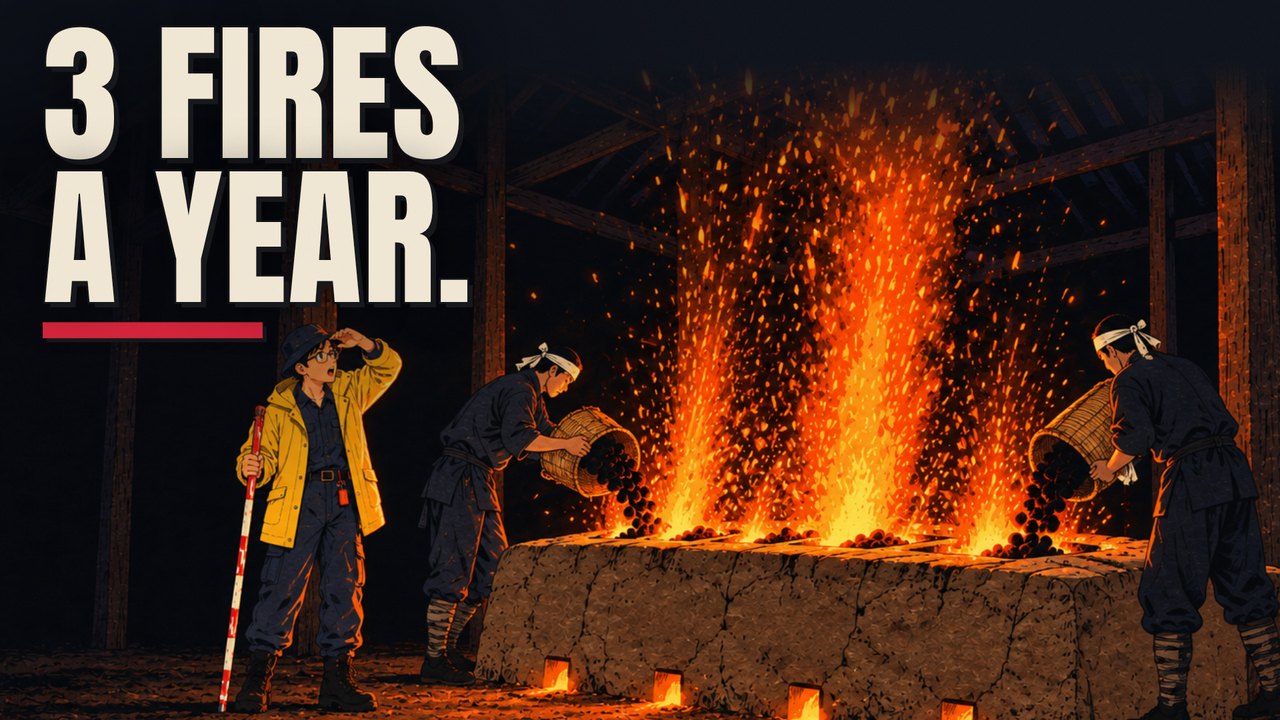
The katana in this story starts as black iron sand, smelted in the only furnace in Japan that still makes steel the traditional tatara way, where the fire is lit just three times a year (Japan Tourism Agency; Japan Tourism Agency). A smith with at least five years of training folds and shapes the steel by hand, gives a long blade at least 15 days of work, heats it to about 800°C and plunges it into cold water, which is when it curves (Agency for Cultural Affairs; Aomori Prefecture; Japan Tourism Agency; Bizen Osafune Sword Museum). Even then, it is legal to own only once a prefectural panel registers it as a work of art (Agency for Cultural Affairs).
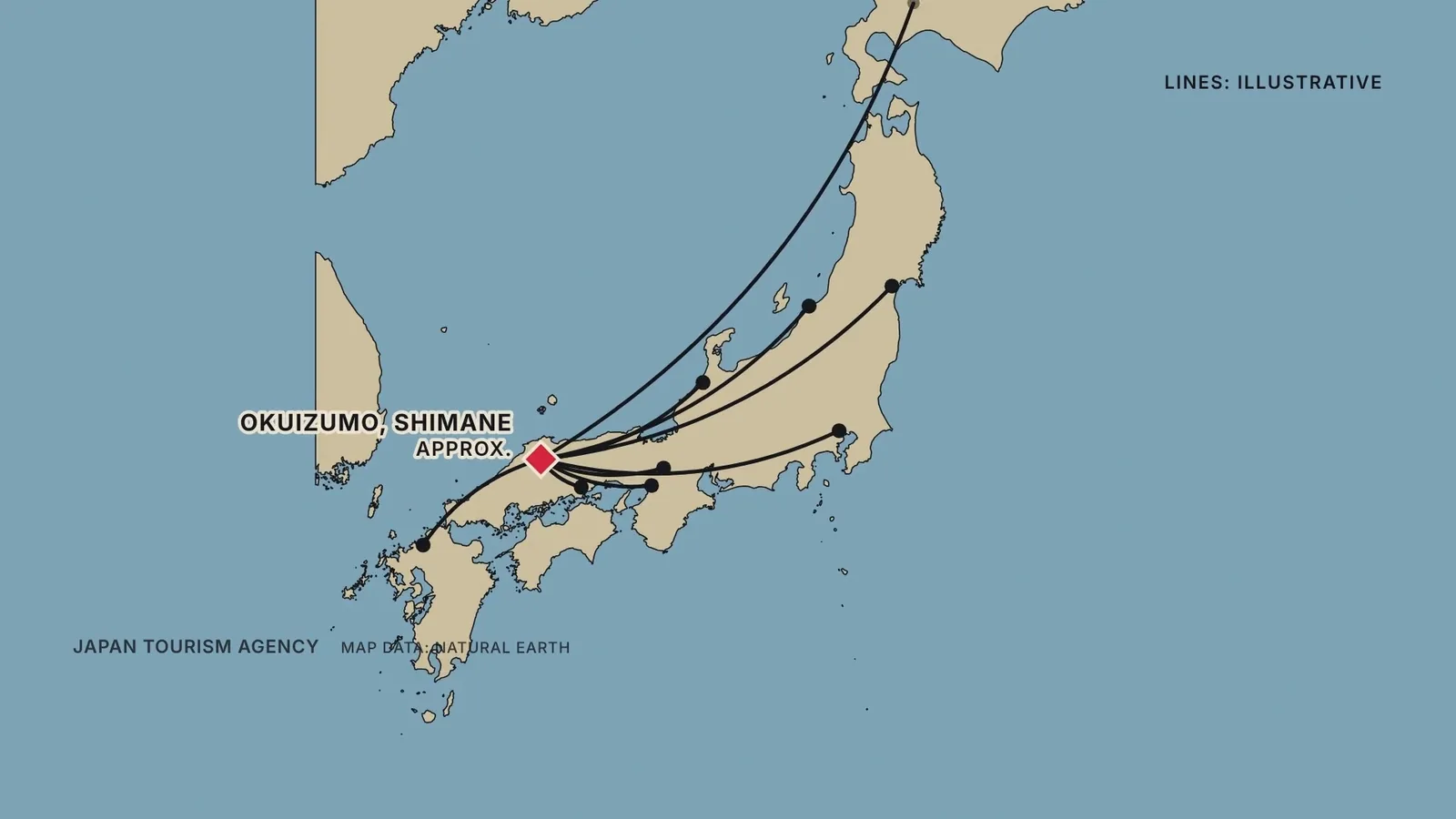
Why there is only one furnace
By the end of the Second World War, almost no one in Japan was making this steel, and only about 5 to 6 tonnes of the old steel, tamahagane, were left in the whole country. The fires stayed out for 30 years. In 1977 a sword preservation society, the NBTHK, lit one again in the mountains of Shimane (Japan Tourism Agency). The same year, the government listed the method, tamahagane production by tatara-buki, as a selected conservation technique, a craft to be preserved (Shimane Prefecture).
It still burns there. The fire is lit three times each winter; the society’s plan for fiscal 2025 put the runs between late January and mid-February (NBTHK), and the 2026 season opened with a fire-lighting ceremony on January 21 (Shimane Prefecture).
Sand: seventy hours in a clay furnace
This blade’s story starts with black iron sand from the hills around the furnace. By one report, only about 0.5% of the hillside sand is iron sand, so a winter’s 30 tonnes of iron sand come from roughly 6,000 tonnes of sand (Bunshun Online).
For each run, the crew builds a new furnace by hand, out of clay (Japan Tourism Agency). About a dozen people work it, and some of them are swordsmiths by profession (Bunshun Online; Shimane Prefecture). One person runs the whole fire. The role is called the murage, the master of the furnace, and the government recognizes its holder as the keeper of this skill (Shimane Prefecture).
Then the feeding starts: iron sand, then charcoal, about every half hour, day and night for 70 hours. By the end, about 10 tonnes of iron sand and 12 tonnes of charcoal have gone in (Japan Tourism Agency).
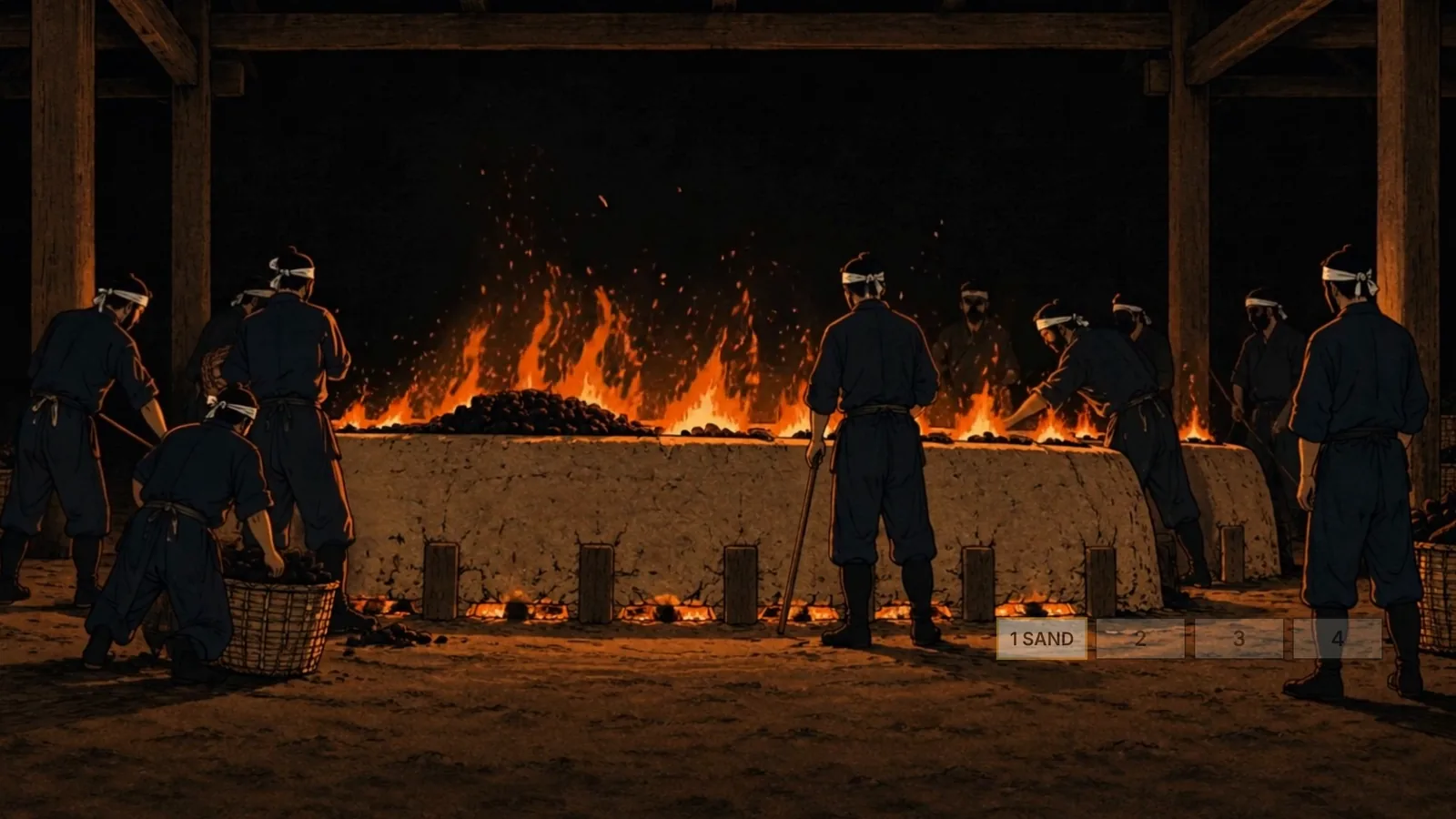
On the fourth morning, the crew breaks its own furnace apart (Japan Tourism Agency). Inside there is no sword, just one glowing lump of iron and steel called a kera. Sources put it at about 2.5 to 3.2 tonnes; the video rounds it to about three (Japan Tourism Agency; Japan Tourism Agency; Bungeishunju; our math). Because the furnace is rebuilt for every run, three fires a year means three new furnaces a year.
Steel: sorted by eye
The kera is broken up, and someone looks at every piece. The best steel breaks with a clean, even face: that is tamahagane. It is graded mostly by carbon. Grade 1 has about 1.2%, grade 2 from 0.8 to 1.5%, grade 3 from 0.2 to 1.0% (Japan Tourism Agency).
Each year, in spring, the steel is sorted, graded and sold to swordsmiths across Japan (Japan Tourism Agency); the society hands out the year’s tamahagane from late June (NBTHK). Some of it changes hands at the society’s training course, where smiths gather and choose their own (NBTHK).
Which furnace it came from matters. The main national contest for new swords, the NBTHK’s Contemporary Sword Craft Exhibition, asked smiths in its 2019 rules to use tamahagane from Nittoho Tatara, in principle, and said entries that didn’t would not be judged (NBTHK). That is a contest rule, not the law: we found no law or regulation that requires tamahagane.
The smith needs approval first
A smith can’t just decide to make swords. In Japan, that takes approval. A first application goes to the Commissioner of the Agency for Cultural Affairs and needs at least five years of training under an approved smith, a guarantee from at least two registration examiners, and completion of a training course for swordsmiths (Agency for Cultural Affairs).
The NBTHK runs a hands-on swordsmithing course; in 2024 it ran for four days in September, one stage a year: forging in the first year, shaping in the second, quenching in the third (NBTHK). Its name differs from the course in the Agency’s rules, and we could not confirm that the two are the same. The approval is not only for Japanese nationals; in 2024 a foreign national earned it for the first time (Government of Japan). We found no official count of swordsmiths. By one estimate, around 200 people hold the approval today, and not all of them still forge (National Geographic).
Fold it, then fold it again
For a finished blade of about 1 kg, the smith starts with about 4 kg of tamahagane. Most of it is lost along the way. He hammers the chunks flat, breaks them into small pieces and stacks them on a block, coats the stack in clay and ash, and heats it until it welds into one. Then he folds it: hammer it long, cut it halfway, fold it back on itself, again and again (Japan Tourism Agency).
Every fold doubles the layers, so fifteen folds would give 32,768 in theory, close to the about 33,000 layers the Japan Tourism Agency describes (Japan Tourism Agency; our math). It is a theoretical count, and the number of folds varies from smith to smith. A blade made only of hard steel would cut well, but it could snap. So the smith also forges a second, softer steel.
Blade: hard outside, soft inside
He wants an edge that is hard and a body that can bend without breaking. The answer is to put one inside the other: a skin of hard, high-carbon steel, the kawagane, around a core of softer, low-carbon steel, the shingane (Japan Tourism Agency).
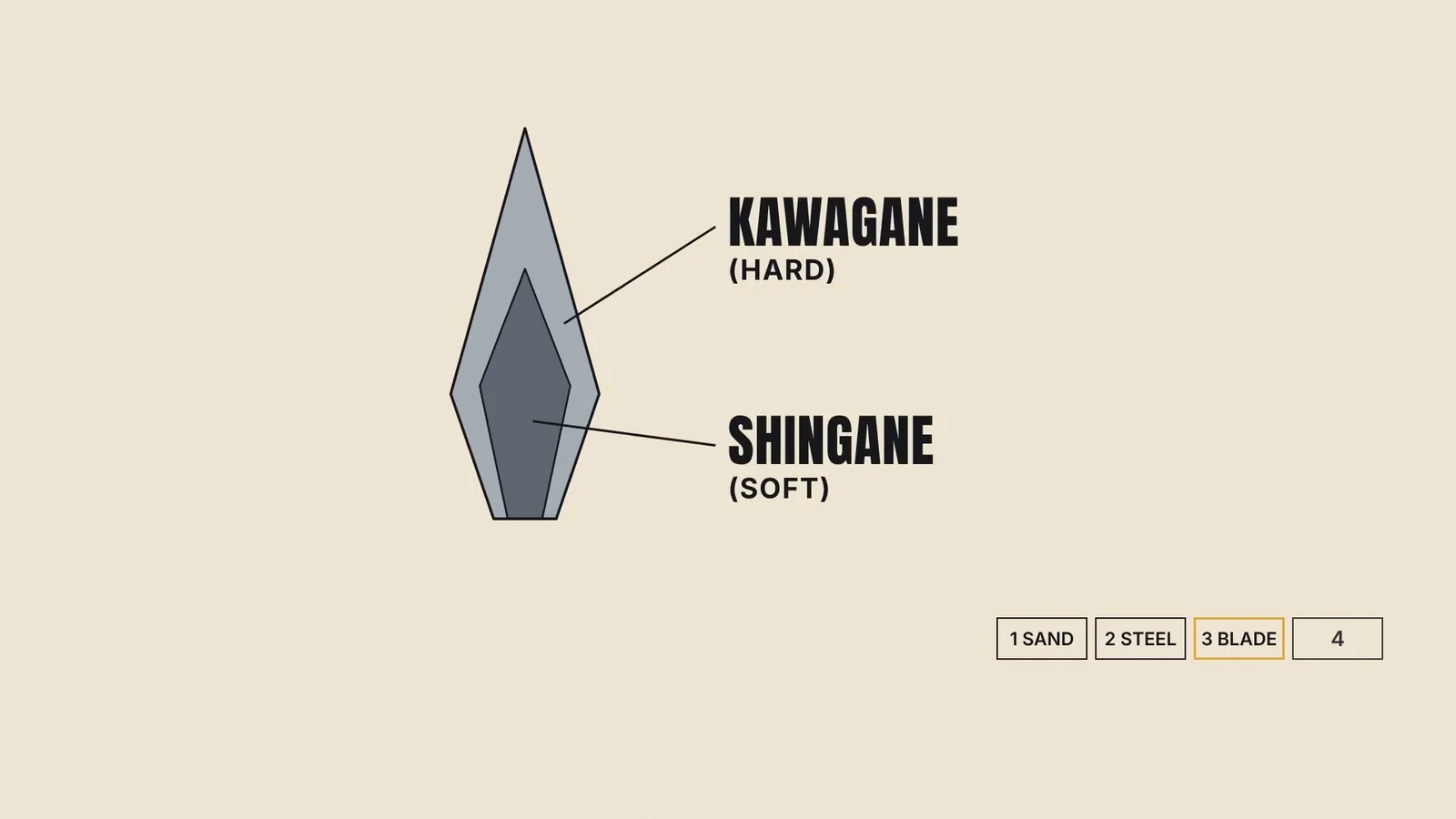
He hammers the bar out to the length of a sword, then shapes the point, the ridge and the edge. After all that hammering, the blade is still nearly straight.
The curve appears in the water
Next, he paints the blade with clay: a thin layer along the edge, a thick layer over the back. He heats it to about 800°C and plunges it into cold water (Japan Tourism Agency). The curve appears right there, in the water (Bizen Osafune Sword Museum).
Under the thin clay, the edge cools almost instantly. It turns very hard and swells slightly, and that swelling pushes against the softer back, so the whole blade bends; a 1990 study that measured one old blade traced the curve to this expansion of the hardened edge (Weins & Bleed). For a moment the blade even bends the wrong way, downward, before it swings up into the curve. Researchers once had straight test pieces quenched the traditional way, and every one of them curved (Arimoto & Iyota).
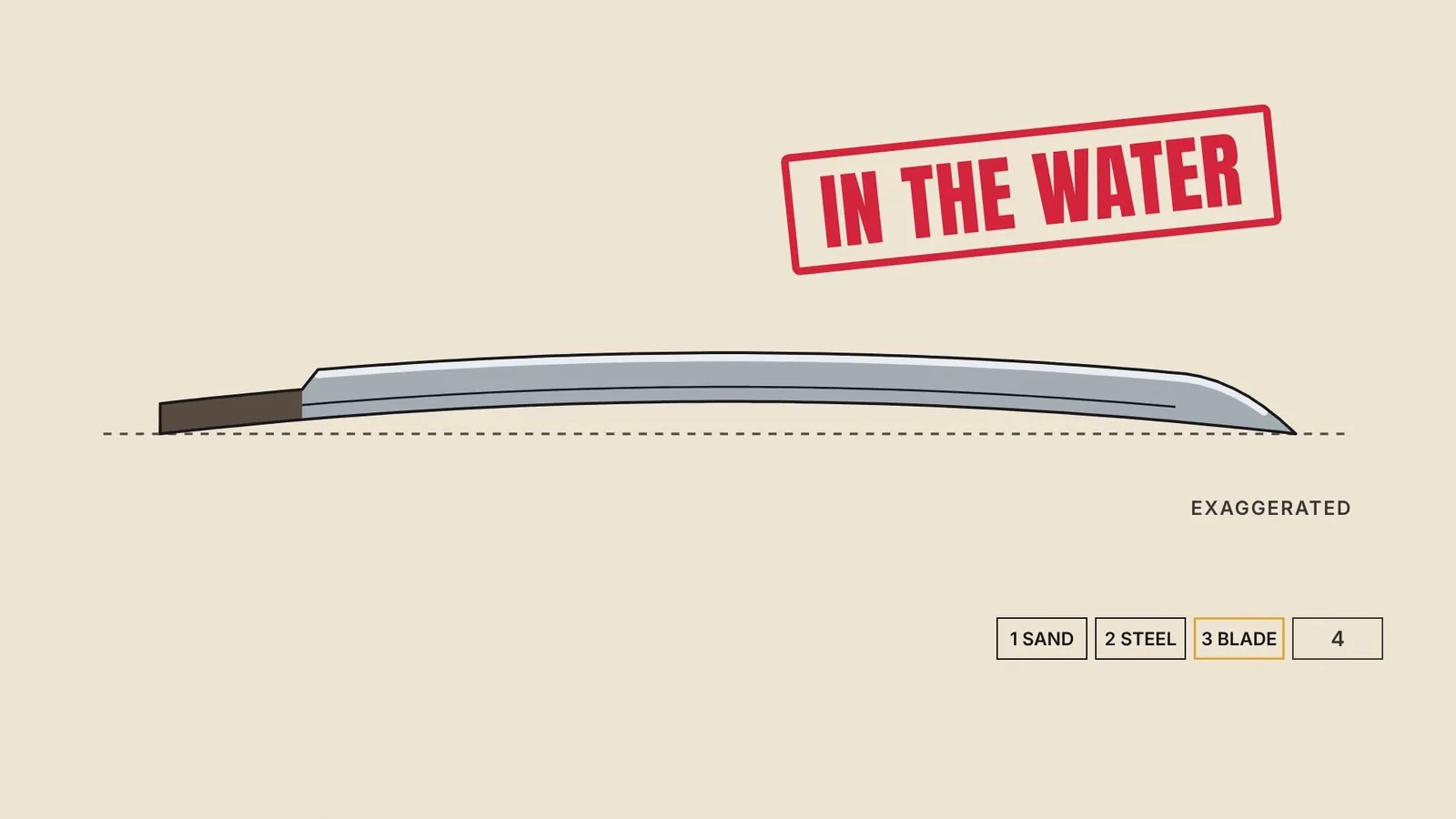
In one test, the edge was about four times as hard as the core (Japan Tourism Agency). The border between hard and soft stays on the steel as a visible pattern, the hamon.
At least 15 days for every long blade
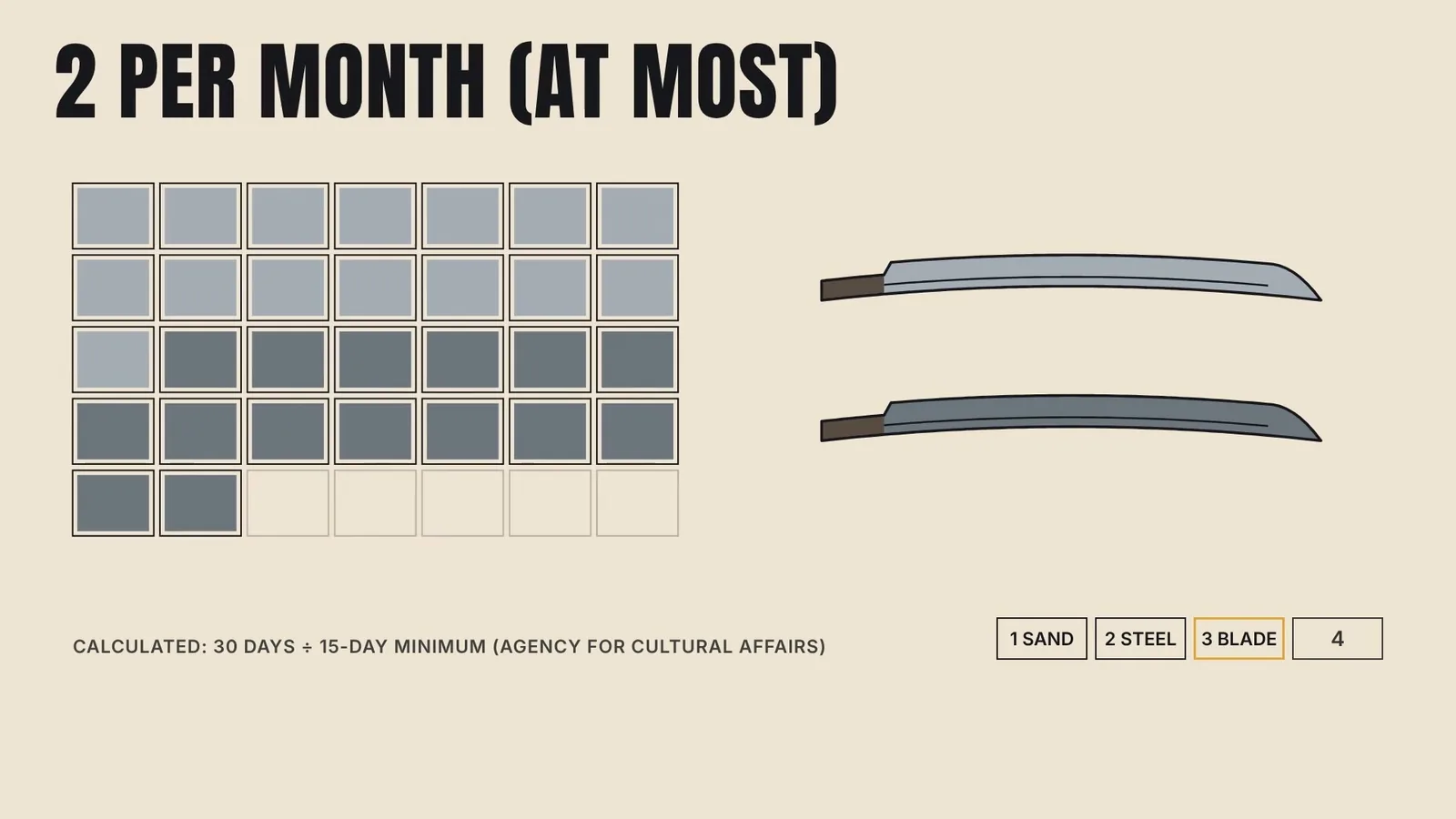
None of it can be rushed. The one published screening standard we found, Aomori Prefecture’s, gives every long blade, a tachi, katana or naginata, at least 15 days of work, and a short blade such as a wakizashi or tanto at least 10 (Aomori Prefecture). The Agency for Cultural Affairs says it does not set how many swords can be made; what it sets, by notice, is the minimum number of days each type of sword must take (Agency for Cultural Affairs). There is no cap on output, only a floor on how long each blade takes. At that pace, by our calculation, two long swords a month is the most one smith can make (our math).
Then the blade leaves the smith. A specialist polisher works it across a series of stones, each finer than the last; the foundation polish alone uses seven or eight kinds (Bizen Osafune Sword Museum). Other craftsmen make the collar, called the habaki, the fittings and the scabbard (Bizen Osafune Sword Museum), and the smith signs the tang with a chisel (Japan Tourism Agency). Altogether, a blade like this can take weeks or months (Government of Japan). It is finished. But you still couldn’t take it home.
Paper: why a finished sword still needs one
The reason goes back to the autumn of 1945. Japan had lost the war, and in September the occupation authorities ordered the country’s swords handed in. Hundreds of thousands were collected, and many ended up piled in a US Army warehouse at Akabane, in Tokyo. In 1947, about 5,500 of the finest were handed back (Hiroshima Prefectural Museum).
From 1946 there was one way through. Under an imperial ordinance that took effect on June 15 that year, a sword judged to be a work of art could be kept with a permit from the prefectural governor (Supreme Court of Japan). That rule still decides everything. The current law, from 1958, provides for registering swords that have value as art objects (House of Representatives). In Japan, a sword is registered as art, not licensed as a weapon.
Registered as art, not licensed as a weapon
So every new sword goes before the prefecture’s experts; registration is handled by each prefecture’s board of education (Agency for Cultural Affairs). They are not asking whether it can cut. The test is whether its shape, its forging and its hamon show beauty, or whether it clearly carries the traditional features of a school of smiths (Supreme Court of Japan). If the answer is yes, it gets a registration certificate.
It also has to be a Japanese sword. In a ruling of February 1, 1990, Japan’s Supreme Court upheld the refusal to register two sabers their owner had bought in Spain (Supreme Court of Japan). The certificate is the paper and stays with the sword wherever it is kept or carried (Agency for Cultural Affairs).
By one older count, from 2007, about 2.45 million swords in Japan carry a paper like this (Tokyo Metropolitan Board of Education). And the moment a sword leaves Japan, its paper stops counting: the certificate becomes void and goes back to the prefecture that issued it (Saitama Prefecture). Taking a sword abroad needs the government’s export clearance first (Saitama Prefecture; Agency for Cultural Affairs).
From sand, by hand, only as art
So a katana like this one is still made in Japan from sand, in a clay furnace that is built and broken every time it runs; from steel sorted by eye and folded by hand; and from one plunge into water that bends the blade. Then Japan’s rules slow it down: years of training before the first blade, weeks of work for every long blade, and one piece of paper at the end.
Each of those rules treats a sword as art, not as a weapon, and that idea is what let swords stay in Japan after 1945. In Japan, a katana like this is still made from sand, by hand, and only as art. Three times a year, in the mountains of Shimane, the fire is lit again.
For the previous episode in this series, see How Japan Keeps a Sinking Airport Above the Sea.