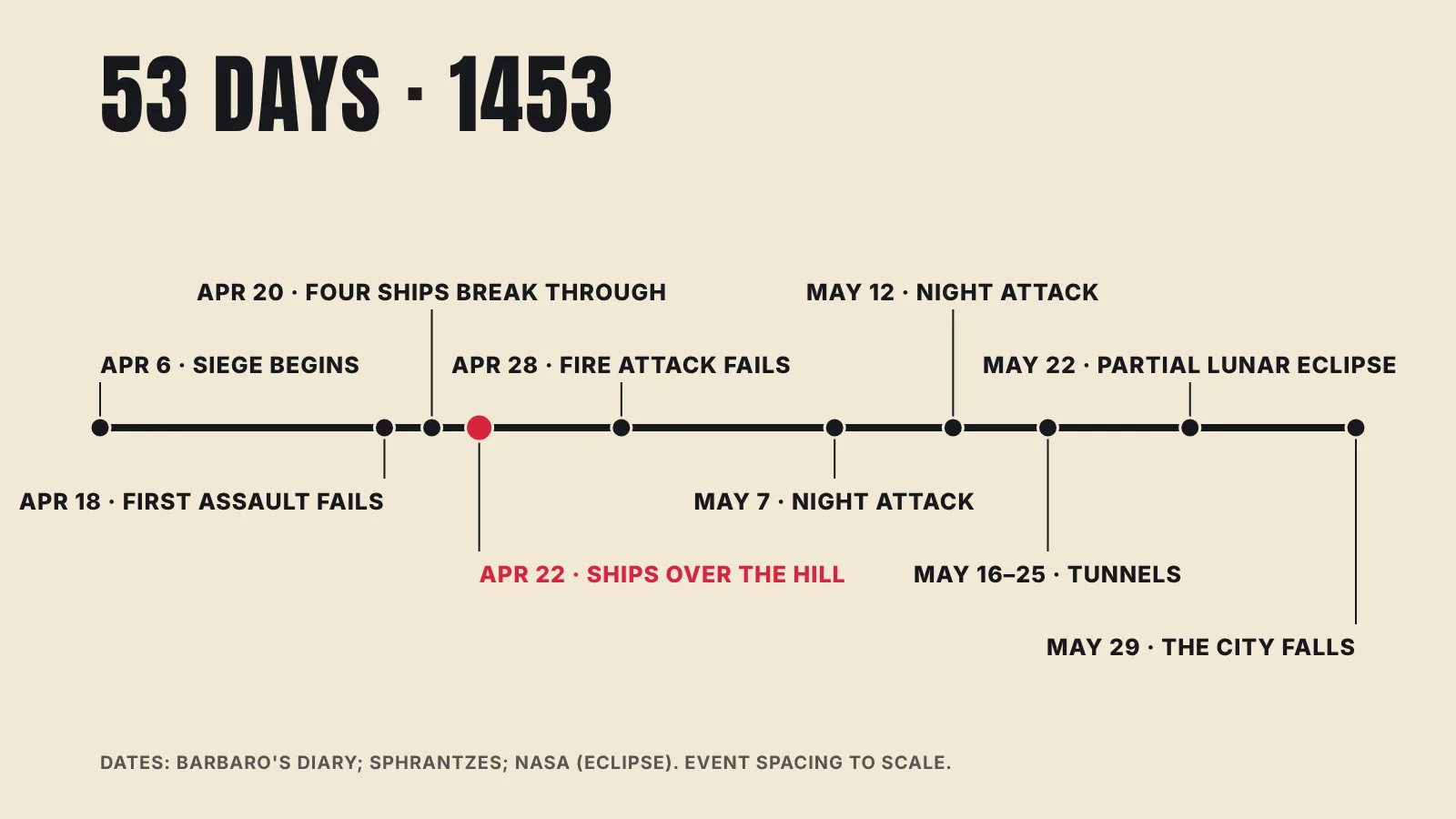
Constantinople fell on May 29, 1453, after a siege of 53 days, counted from April 6, the start date Doukas gives (Doukas). The 21-year-old sultan Mehmed II’s giant cannon broke holes in the land walls, but it could fire only about seven times a day (World History Encyclopedia). What decided it was some 70 ships dragged over a hill into the harbor, which forced fewer than 8,000 defenders onto a second front, and a last morning when the thinned line broke as its wounded commander was carried away.
The count depends on where you start: the army arrived over several days, so accounts begin anywhere from April 2 to 7, and Britannica counts 55 days (Britannica; our math).
The wall: one open side
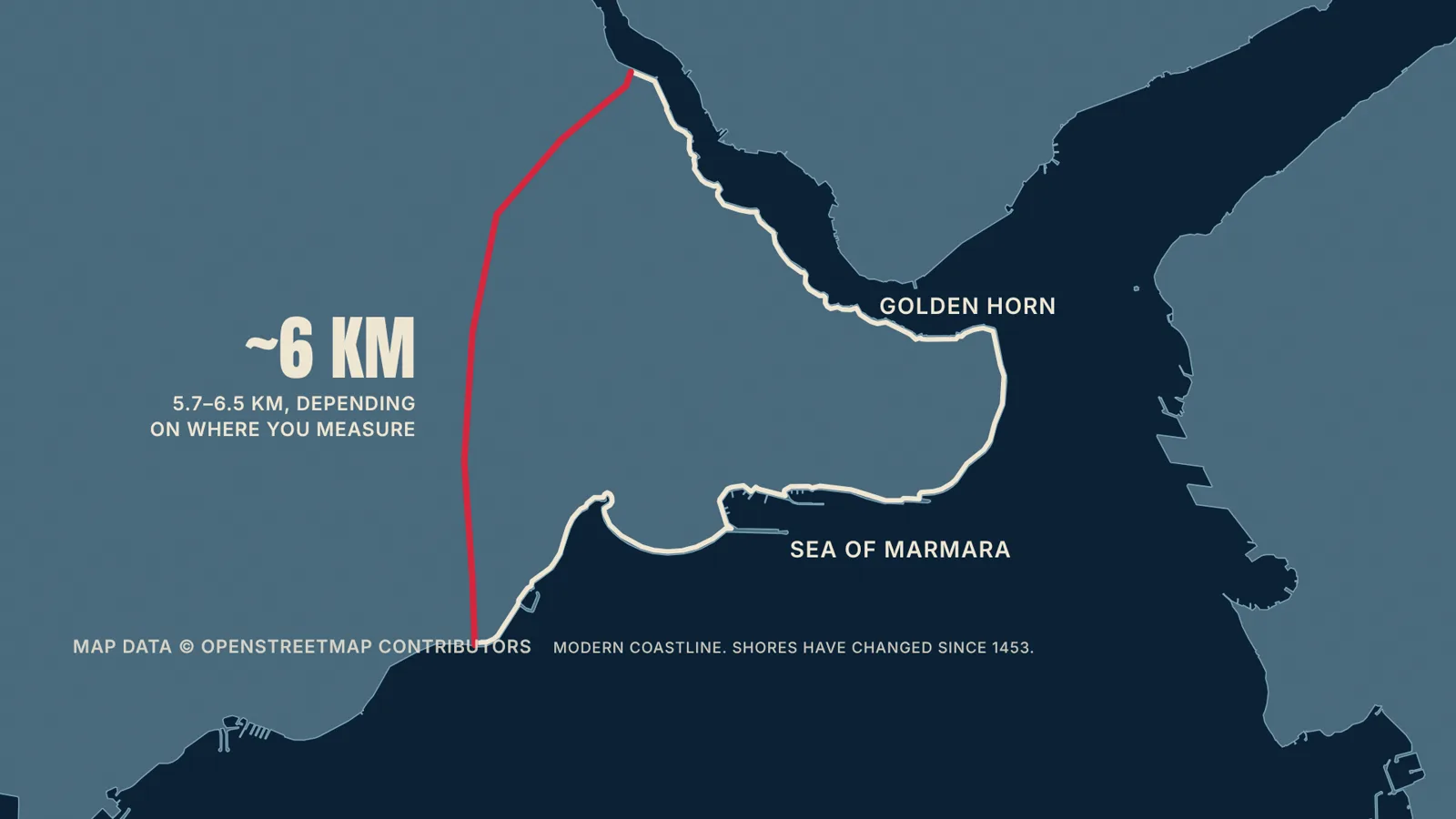
Constantinople sat on a triangle of land with water on two sides, the Sea of Marmara and the Golden Horn. Across the third, the Theodosian land walls ran about 5.7 km, or 6.5 km including the northern stretch near Blachernae: roughly an hour’s walk (Wikipedia; World History Encyclopedia; our math).
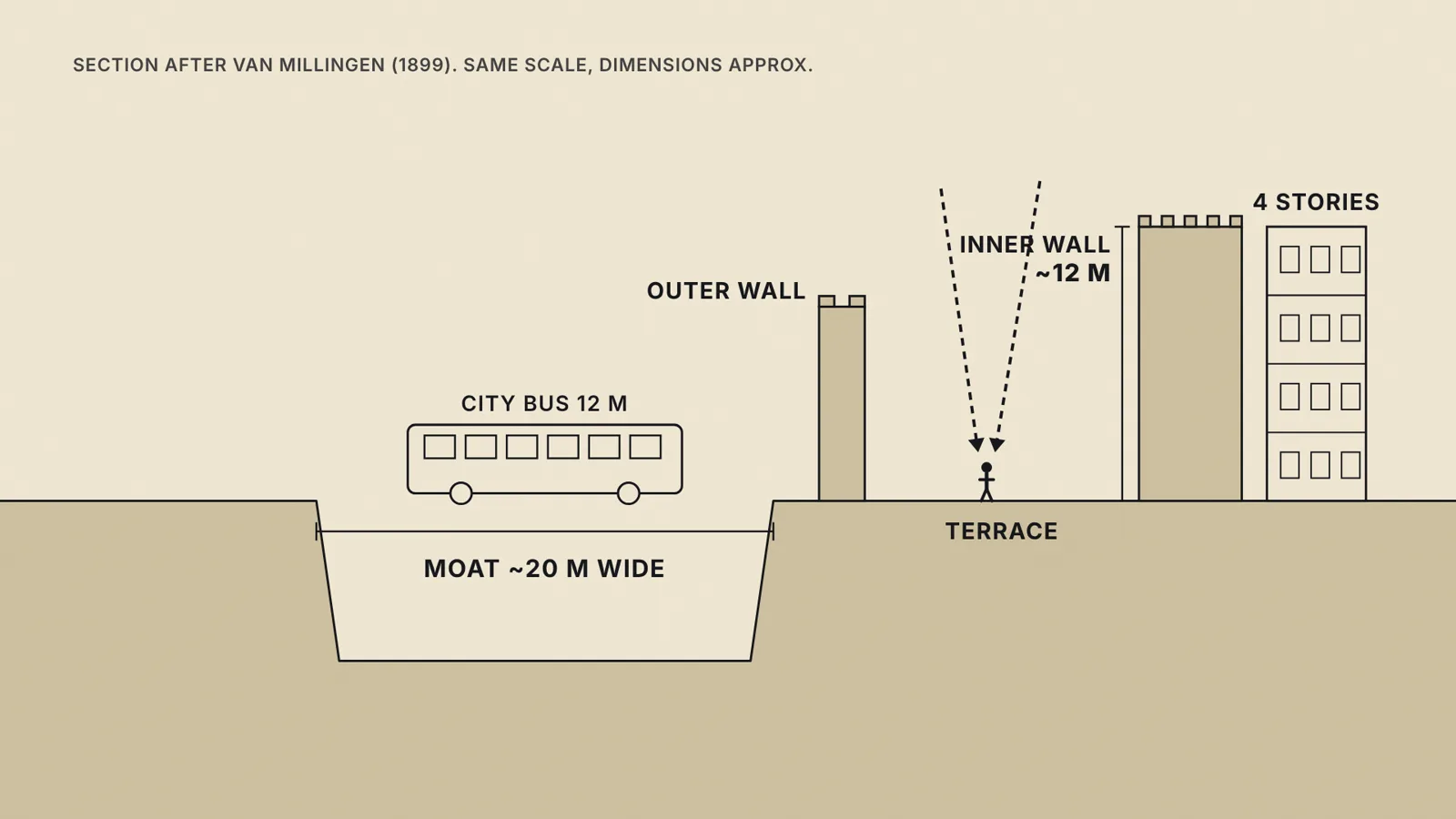
An attacker from the west met the defenses one behind the other: a moat about 20 m wide, wider than a city bus is long (World History Encyclopedia; Van Millingen), then an outer wall, a terrace, and the inner wall, about 12 m high, roughly four stories, with 96 towers (World History Encyclopedia).
The walls went up in 413. In 447 earthquakes brought much of them down, with Attila’s Huns nearby (Van Millingen). Inscriptions say the rebuilding took about two months; the rival chariot-racing factions, the Blues and the Greens, supplied 16,000 laborers (Van Millingen).
Avars and Persians, Arabs, Bulgars and Rus besieged the city in the centuries that followed (World History Encyclopedia). In 1422 the Ottoman sultan Murad II tried and failed too (World History Encyclopedia; Pears). His son would come back. The one time a foreign army took the city, in 1204, the Crusaders came in from the harbor side; the land walls were never broken by assault (Van Millingen). (Byzantine forces did get in from the land side in 1081 and 1261, by bribing guards and through a hidden passage, not by storming the walls.)
Two men
By 1453 the empire behind the wall had shrunk to little more than the city, a few towns and the Morea in southern Greece, with Ottoman land nearly all around it. Its emperor, Constantine XI, had little money and few soldiers. To win Western help he had agreed to unite his church with Rome’s, which many of his own people opposed (Britannica; Doukas). Most of the help never came. One Genoese captain, Giovanni Giustiniani, arrived on January 26 with two ships and 700 men, and the emperor put him in charge of the land walls (Barbaro).
The emperor’s secretary, George Sphrantzes, counted every Greek who could fight. The total was 4,773, plus about 200 foreigners, and the emperor ordered it kept secret (Sphrantzes). Doukas puts the city’s armed men at no more than 8,000 (Doukas). Spread around a circuit of walls of about 19 km, that is one man every few meters (World History Encyclopedia; our math).
The man outside was less than half the emperor’s age. Mehmed II had first been made sultan at 12 (Britannica); the emperor was 48 or 49 (Britannica). Within two years Mehmed was pushed aside and his father, Murad II, returned, with help from the chief minister, Çandarlı Halil Pasha (TDV). Halil was still chief minister in 1453, and wary of the siege (TDV). Doukas tells of Mehmed calling him in at night and holding up a pillow he had dragged around all night, sleepless over the city (Doukas).
Mehmed moved first. In 1452 he built a fortress on the Bosphorus in about four months (Doukas; Barbaro). In November a Venetian ship that tried to pass without stopping was sunk, and its captain was executed (Barbaro; Doukas). Then a cannon founder, Orban, who had offered his skills to the emperor and gone unpaid, went to Mehmed, who paid him so well that, Doukas says, a quarter of it would have kept him in the city (Doukas).
The cannon: seven shots a day
Orban cast his giant gun at Edirne. One modern account gives its length as about 9 m, about two cars end to end, and its stone balls as about 500 kg (World History Encyclopedia; our math). Estimates vary, because the old units are hard to convert. In a test, a ball landed a mile away (Doukas). Sixty oxen hauled it toward the city through February and March, with men on each side to steady it and carpenters ahead building bridges (Doukas).
In Japan that year, samurai still fought with bows and swords. European matchlock guns arrived only in 1543, on Tanegashima, 90 years later (Kagoshima Prefecture).
By early April the Ottoman army was camped before the walls, and on April 6, Barbaro records, the emperor sent the crews of the Venetian galleys to man the land walls; he took his own post there (Barbaro). Its size is disputed: Sphrantzes wrote of 200,000 (Sphrantzes); a modern estimate is 60,000 to 80,000 (World History Encyclopedia), perhaps eight or ten attackers per defender (our math).
The great gun could fire only about seven times a day, because it needed time to cool (World History Encyclopedia; Pears). Smaller guns fired far more often, and together they wore the wall down. The first big assault on the damaged section, on April 18, failed (Pears). On April 21, near the Gate of Saint Romanus, a tower and stretches of wall came down (Barbaro). Each night the defenders filled the gaps with stakes, brushwood and containers of earth, and in that soft material, Kritoboulos noted, the stone balls were simply buried (Kritoboulos).
The chain and the hill
The weakest walls were along the harbor, where the Crusaders had broken in. The defenders closed its mouth with an iron chain held up on wooden floats, from the city to the walled town of Galata on the far shore (Van Millingen).
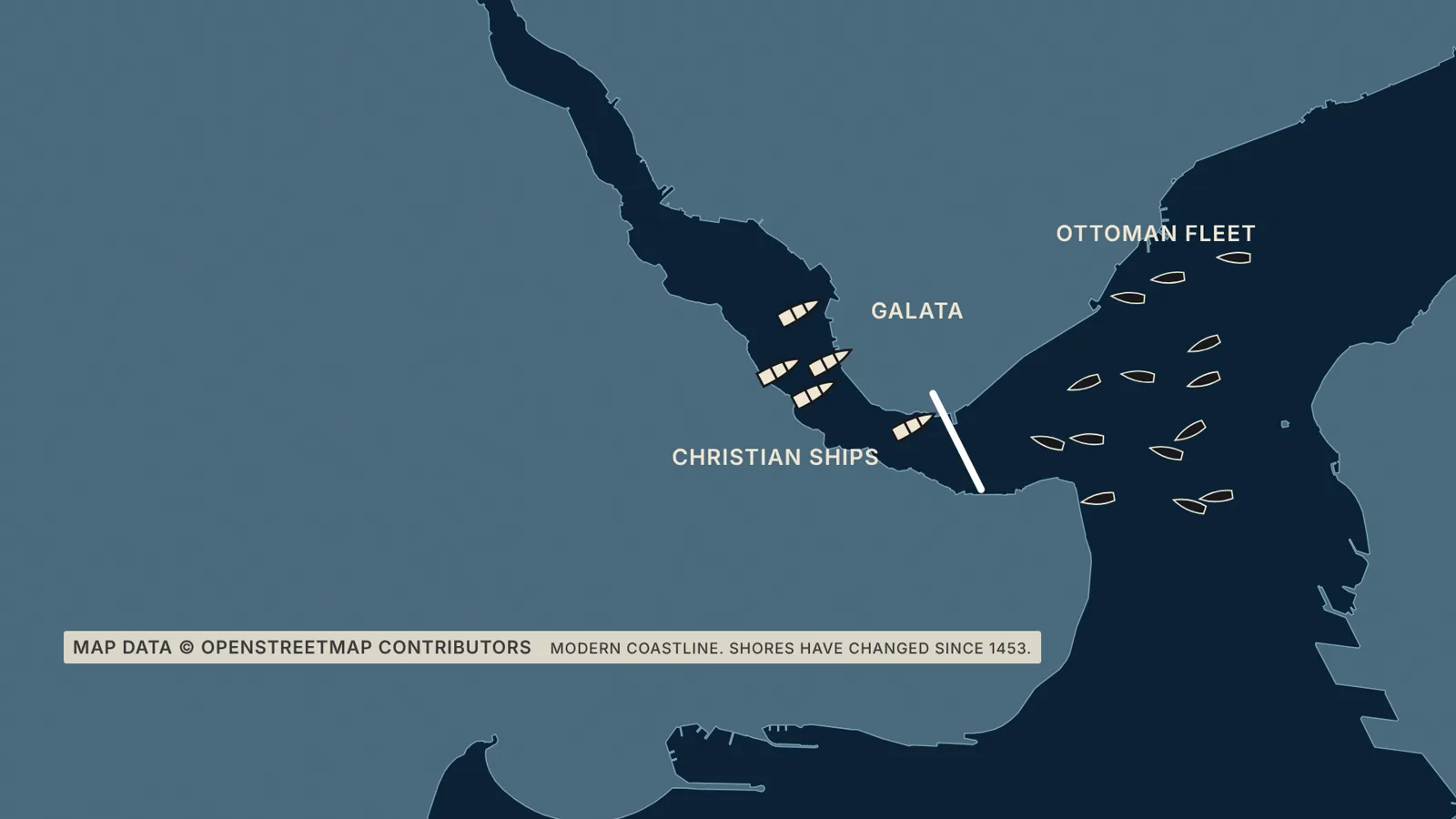
On April 20, four supply ships fought through the Ottoman fleet for hours while the sultan watched from his horse on the shore; then a south wind filled their sails and carried them into the harbor (Kritoboulos). Doukas says Mehmed rode into the sea in his anger (Doukas). He removed his admiral from command (Kritoboulos).
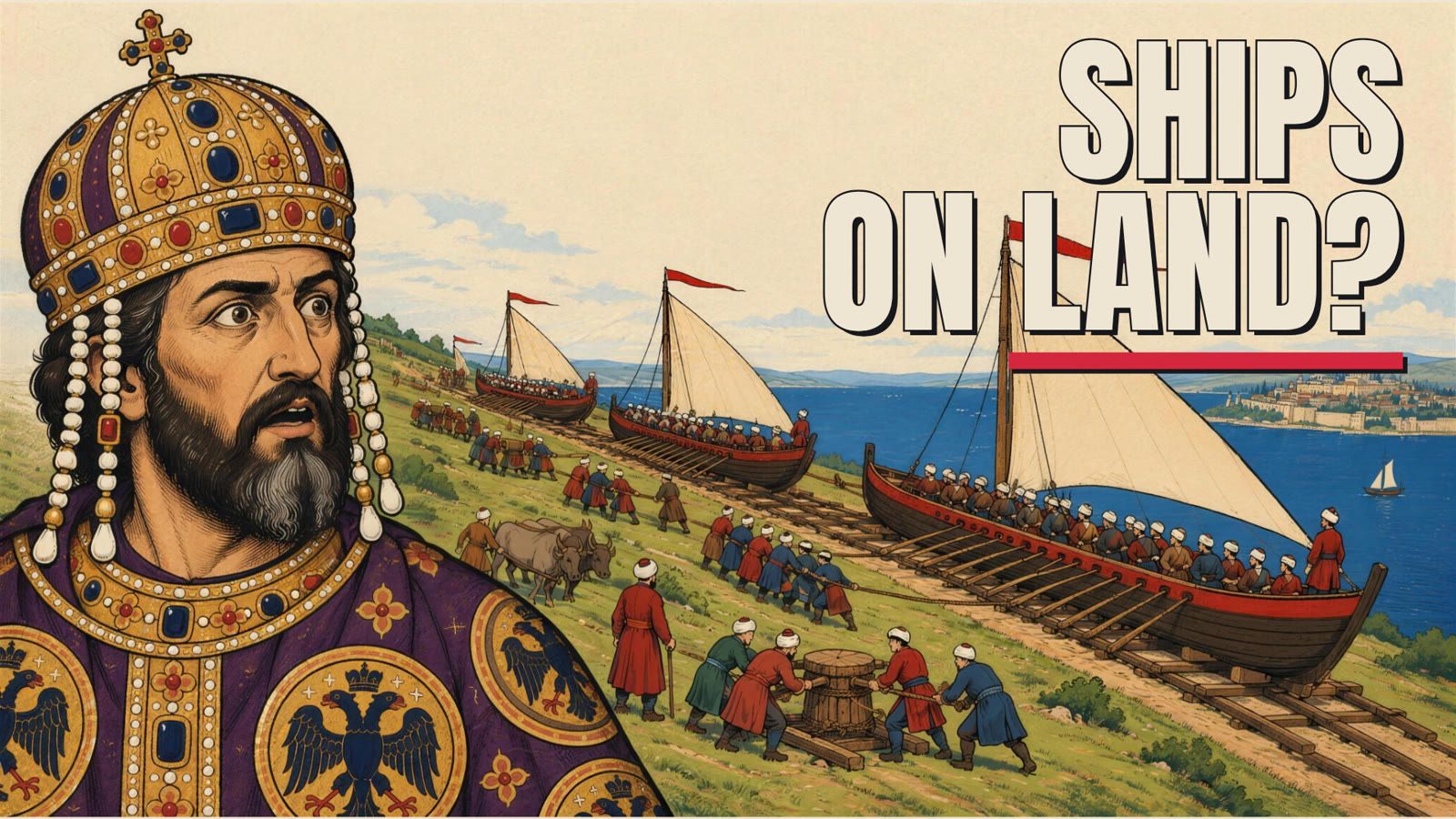
On April 22 the defenders woke to Ottoman warships inside the Golden Horn, behind the chain (Doukas; Barbaro). They had been hauled from the Bosphorus near the Double Columns, over the hill behind Galata. Kritoboulos describes a timber track and ships on cradles pulled by ropes, by hand and by capstans, their crews at the oars with sails raised as if at sea (Kritoboulos). The sources disagree on the number: 67 in Kritoboulos, 72 in Barbaro, 80 in Doukas (Kritoboulos; Barbaro; Doukas). The exact route is also debated.
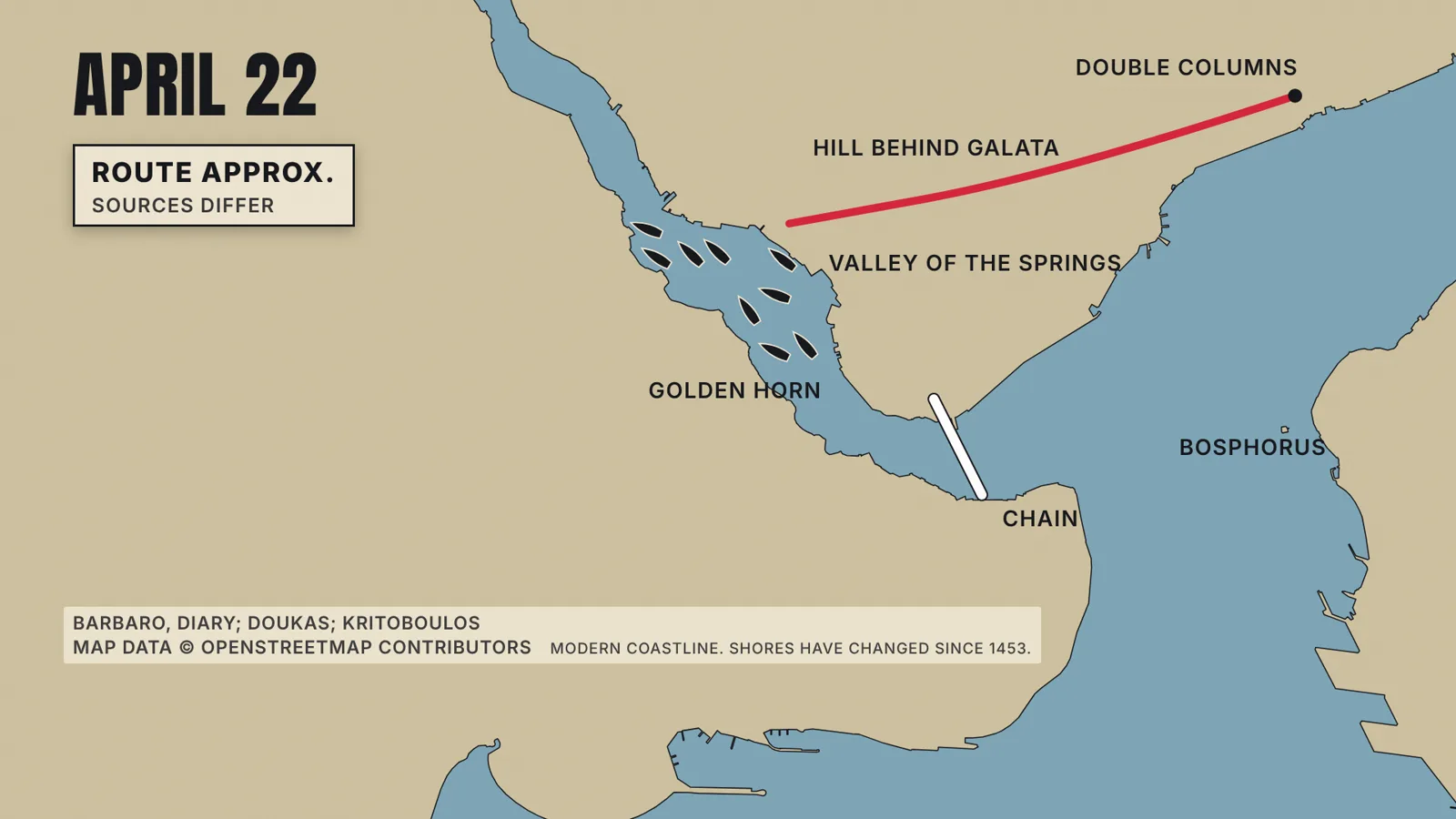
The ships did not need to win a battle. The long harbor wall now needed guarding, and men had to be taken from the other walls (Kritoboulos). On April 28 a night attack to burn the new fleet failed; Barbaro blamed a warning from Galata, a charge still debated (Barbaro; Doukas).
Who runs out first?
Through May the guns kept firing, and inside, food ran short (Barbaro). Night attacks on May 7 and 12 were thrown back. From May 16 the defenders found Ottoman tunnels, dug their own to meet them and destroyed them; on May 23 captured diggers revealed where the others were. A wooden siege tower built in one night, on May 18, failed too (Barbaro).
On May 22 the moon rose partly eclipsed (NASA). Barbaro recorded a prophecy that the city would not be lost until the full moon rose waning (Barbaro). Around then, Kritoboulos writes, the city’s most sacred icon slipped and fell during a procession; hail followed, and the next day fog (Kritoboulos).
In the Ottoman camp, Halil Pasha urged lifting the siege; Zaganos Pasha and others argued for attack, and Mehmed chose to attack (TDV; Pears). For three nights before the assault, the camp burned two fires to a tent (Barbaro).
May 29, 1453: the last morning
The attack began in the dark, about three hours before dawn (Barbaro). Mehmed sent his army in waves: first the least trained troops, then better-armed soldiers, and finally his elite Janissaries (World History Encyclopedia; Kritoboulos). The first two were thrown back from the stockade near Saint Romanus (Kritoboulos).
Then Giustiniani was hit. The accounts differ on what struck him, an arrow in Barbaro, lead shot in Doukas, a crossbow bolt in Kritoboulos, but agree the wound was bad (Barbaro; Doukas; Kritoboulos). He was carried into the city; his men followed, though the emperor begged them to wait (Kritoboulos). The wall still stood; the line of men holding it did not. Ottoman soldiers pushed over the stockade near the Gate of Saint Romanus (Barbaro; Kritoboulos).
Doukas adds a second story: a small postern to the north, the Kerkoporta, had been left open, and about fifty men got in (Doukas). It rests on his account alone, and historians debate it.
Constantine XI, the last Roman emperor, died fighting that morning; the sources differ on where he fell (Britannica; Kritoboulos). Mehmed was 21. His father had gone home from these walls in 1422 (Pears); he had not.
The soldiers had been promised three days of plunder (Pears), but in both Kritoboulos and Doukas the sack plays out within a single day: dawn to evening in Kritoboulos, 6 a.m. to 2 p.m. in Doukas (Kritoboulos; Doukas). By Kritoboulos’ count, nearly 4,000 people were killed in the fighting and the capture, and a little over 50,000 taken captive; other estimates of the captives vary (Kritoboulos; World History Encyclopedia).
Kritoboulos, who later served Mehmed, wrote that the sultan wept at the destruction (Kritoboulos). Doukas says that in Hagia Sophia he stopped a soldier breaking up the marble floor, saying the city’s buildings were his (Doukas). Giustiniani escaped by ship and died in June (Foundation of the Hellenic World). Halil Pasha was arrested on May 30, amid rumors of bribes, and executed about forty days later (TDV). Orban’s fate is unknown.
What decided it
The cannon made the holes and kept the defenders rebuilding every night until they were exhausted. The ships split them: every man sent to the harbor wall was missing from the land wall. On the last morning the line broke where it was thinnest, when its commander was carried away. The cannon made the hole; the ships made sure no one was left to fill it.
You will often hear that the fall started the Renaissance or sent Columbus west. Neither holds up. Manuel Chrysoloras was teaching Greek in Florence from 1397, more than half a century earlier (Rutgers DBCS). And Lybyer showed in 1915 that the fall did not cut the trade routes to the East; when trade later shifted, it was “not by the Turks, but in their despite” (Lybyer).
What did end was the Roman Empire’s last capital and its last emperor. A few Byzantine territories held out a little longer, the Morea until 1460 and Trebizond until 1461 (World History Encyclopedia). The Ottomans made the city their capital. Today it is Istanbul.
For another city’s whole history on the map, see The Entire History of Kyoto.