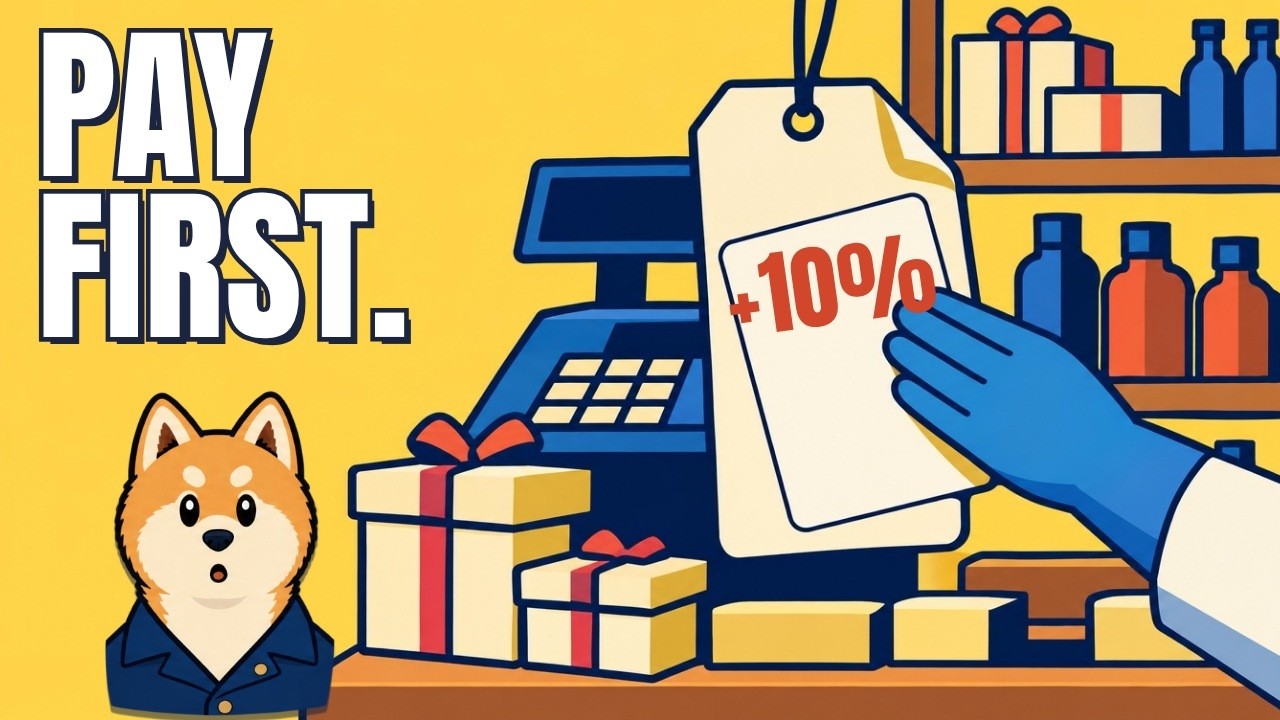
Japan stopped giving tourists tax-free prices at the register because, under the old system, the discount came before the proof. From November 1, 2026, visitors pay the full price in the shop, tax included, and get the consumption tax back only after customs confirms at departure that the goods are leaving Japan (Japan Tourism Agency; National Tax Agency). The standard rate is 10%, and 8% for food and drink, so the price at the register rose by as much as ten percent (National Tax Agency).
Japan did not end tax-free shopping. It moved the refund to the way out. The reason is in the government's own review: in fiscal 2022, 374 people each bought more than ¥100 million of tax-free goods, and of the cases customs managed to check, the goods were confirmed to be leaving in just one (MOF, NTA, METI and JTA).
The old deal
Under the old rules, you showed your passport at the register and the tax came off on the spot. In return, you promised that everything would leave Japan with you. Consumables such as snacks and skincare were sealed in special packaging, a clear bag, so they would not be opened before departure, and consumables had a daily cap of ¥500,000 (MOF, NTA, METI and JTA).
The system spread fast. Japan had 5,777 tax-free shops in April 2014 and 61,392 at the end of September 2024 (Japan Tourism Agency; Japan Research Institute). Spending by foreign visitors grew from ¥2 trillion in 2014 to ¥8.1 trillion in 2024, and shopping was the biggest item after accommodation (Japan Research Institute).
But the order mattered. The customs check on the way out was voluntary, and refusing it was not a reason to stop anyone leaving the country (MOF, NTA, METI and JTA). The discount was given first; the proof came later, if at all.
The 374
Most visitors are not who this story is about. In fiscal 2022 (April 2022 to March 2023), 3,718,432 people bought tax-free goods and left Japan. Of them, 374 each bought ¥100 million or more. Together they spent ¥170.4 billion, about 28% of the ¥604.2 billion in tax-free purchases that year (MOF, NTA, METI and JTA). By our calculation, that is about ¥460 million each on average. At the Bank of Japan's rate on November 11, 2026, ¥100 million was over US$600,000.
Over two years, April 2022 to March 2024, 690 people bought ¥100 million or more, spending ¥233.2 billion out of total tax-free purchases of ¥2.4979 trillion, and the review says close to 90% of these high-value buyers could not be checked (MOF, NTA, METI and JTA).
Where did the goods go? The review found many cases in which tax-free goods were suspected of never leaving Japan and of being passed on inside the country instead, and said the methods had become more sophisticated, including splitting purchases into amounts under shops' own limits (MOF, NTA, METI and JTA). The logic is simple: buy without the tax, resell inside Japan at the normal price, and the tax becomes the margin.
Who got the bill
Of the 374, customs caught and checked 57 cases, 15.2%. In one, the goods were confirmed to be leaving. Tax was assessed in the rest; one case paid, and 55 left Japan with the tax unpaid. About ¥1.87 billion was assessed, and about ¥1.85 billion of it remained unpaid. Most of those caught did not have the money to pay (MOF, NTA, METI and JTA). Those 57 are counted as cases, not people.
The tax office was not the only one exposed. Under the old rules, the job of stopping abuse sat with the shop at the register, and if a sale turned out to be abuse, the shop could be billed for the tax (Japan Research Institute; MOF, NTA, METI and JTA). In December 2022, Nikkei reported that Apple's Japan unit had been billed about ¥13 billion in additional consumption tax over tax-free sales, as relayed by Reuters (Reuters); other Japanese outlets put the figure at about ¥14 billion over two years (The Japan Times).
So the review set two goals: shut out the abuse, and build a system in which shops no longer carry the burden of preventing it, while keeping tax-free shopping as a way to grow visitor spending (MOF, NTA, METI and JTA).
The fix: check at the way out
Japan received 42.7 million visitors in 2025 (JNTO via Honichi Lab). Instead of trying to police more than 60,000 shops, the new system checks the one place everyone has to pass.
At the shop, you pay the full price, and the shop sends a record of the purchase to the National Tax Agency's tax-free sales management system. Purchases must total ¥5,000 or more, before tax, at the same shop on the same day (National Tax Agency; Japan Tourism Agency). At the airport or seaport, within 90 days of purchase and before checking your bags, you hold your passport to a terminal. Green means you are done; red means customs wants to see the goods (Japan Tourism Agency; JNTO). At seven airports, Narita, Haneda, Kansai, Chubu, Fukuoka, New Chitose and Naha, the step can also be done by smartphone through Visit Japan Web (JNTO; Travel Watch). Only after customs' confirmation reaches the system does the sale become tax-free, and the shop or a company working for it pays the refund. If there is no confirmation within 90 days, the tax stays (National Tax Agency).
Anything used or eaten in Japan cannot be checked at departure, so it is not refunded. Goods mailed home before leaving are not covered either (National Tax Agency; Japan Tourism Agency). That is why the sealed bag, the ¥500,000 daily cap for consumables and the split between "general goods" and "consumables" are gone (MOF, NTA, METI and JTA; Travel Watch). For expensive items the checking gets tighter: anything priced at ¥1 million or more before tax is recorded with details that identify it, including a serial number if it has one (National Tax Agency). And if goods do not leave, customs can collect the tax, with penalties (National Tax Agency; JNTO).
Under this order, the 55 unpaid bills of fiscal 2022 could not happen in the same way: the tax is paid at the shop before anything leaves.
The price
The cost has moved to honest travelers. They pay the tax up front and add one more step at the airport. The system does not set how refunds are paid, and a refund taken in cash at the airport can carry a fee from the company handling it (National Tax Agency; Japan Research Institute). Fees and refund speed vary by shop and operator.
On November 2, the operator of Don Quijote, PPIH, showed reporters its Shibuya store, with 42 tax-free registers and waits it said were basically under five minutes. It said it would generally cover refund fees, except when customers choose cash at the airport. Two groups of American visitors there said the shop part was easy; one planned to get to the airport early, and the other said a refund in the store would have been more convenient (Honichi Lab). Naha Airport installed 10 terminals (QAB).
An economist at Nomura Securities warned that the change could weigh on visitor demand, mainly shopping, because paying the tax up front raises the psychological hurdle, and that a rush to buy before the switch could be followed by a dip (Nomura Securities). That is a forecast, not a result. Overall figures since the switch, for tax-free sales or airport waiting times, are not yet out.
Not a new idea
The refund-at-departure order is common elsewhere. In April, the chairman of Japan's tax-free shop association tried an airport refund in Europe and called it "extremely smooth", adding that "in some ways, Japan's old system was a bit unusual" (Travel Watch). Some countries went further: Britain ended its VAT retail export scheme for visitors on January 1, 2021, in England, Scotland and Wales, though not in Northern Ireland (OBR; GOV.UK).
Japan kept the refund and moved the proof. The discount used to come before the proof; now the proof comes first, and every honest traveler pays for that with tax up front and one more step at the airport. JNTO's guidance fits in one line: "You must complete the procedure before checking in your luggage" (JNTO).