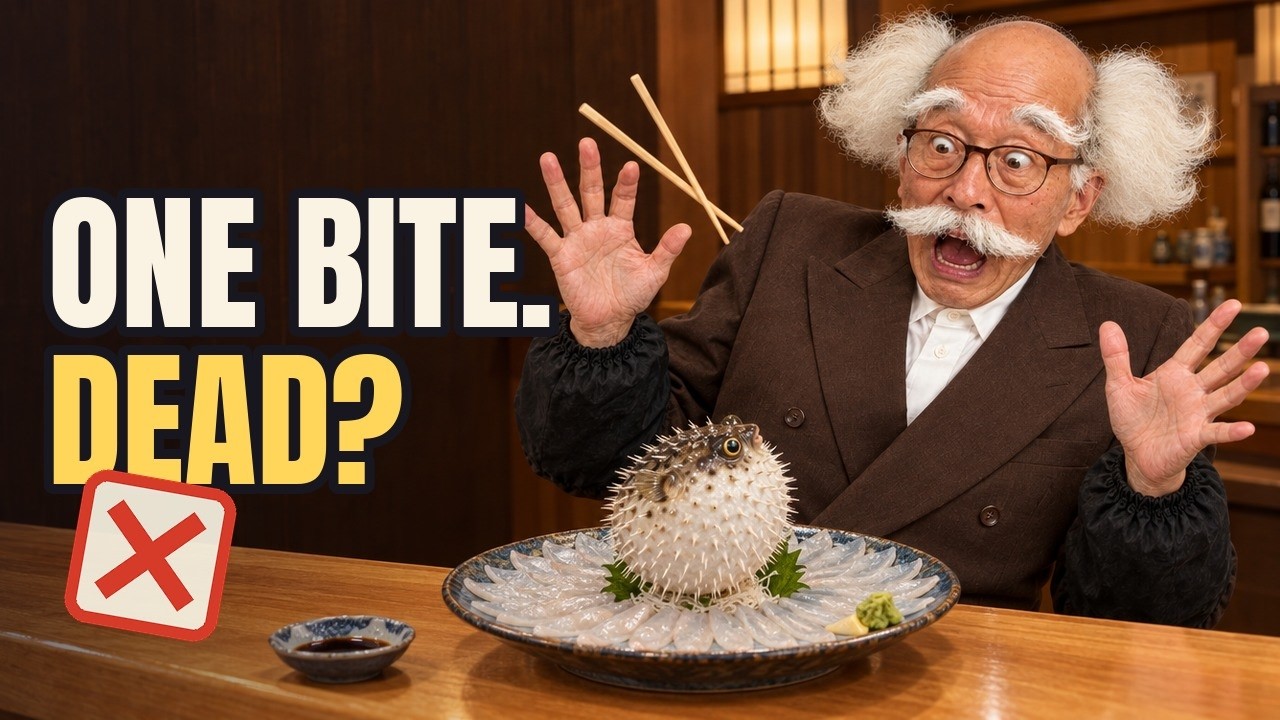
Japan lets you eat fugu, the poisonous puffer fish, because by the time it reaches a restaurant counter the dangerous work has been done under rules. The national government decides which species may be eaten, from which waters and which parts of the body; the person who cleans the fish must hold a license; and the toxic parts are removed and sent to be destroyed (MHLW; MHLW). Selling or serving a banned part, including the liver, is a crime under the Food Sanitation Act (MHLW).
The danger is real, but it mostly lies outside that system. Over the ten years 2015 to 2024, Japan averaged about 16 cases of fugu poisoning and 21 patients a year, and a few people died. Many of the cases involved fish that people caught themselves or were given and cooked at home (Aichi Prefectural Institute of Public Health).
Where the poison hides
The toxin is not spread evenly through the fish. How much there is depends on the species and the body part. In general the liver, the ovaries and the skin carry the most, and in some species even the meat is toxic (MHLW).
It cannot be cooked out. Salting, rinsing, soaking and heating do not weaken it (MHLW; Wakayama Prefecture). If the danger cannot be cooked out, it has to be cut out, and that raises the question of who is allowed to hold the knife.
From ban to rulebook
For a long time the official answer was nobody. The story goes that the warlord Toyotomi Hideyoshi banned eating fugu. Then, the story says, Itō Hirobumi, Japan's first prime minister, was so taken with its taste that in 1888 fugu was allowed again, but only in Yamaguchi Prefecture (Yamaguchi Tourism Federation). These are traditions as told by Yamaguchi's tourism body, not documented history, and we give them as such.
Today the decision belongs to the national government. Since a 1983 notice on fugu hygiene, it has set the species that may be eaten, the waters they may be caught in and the parts that may be eaten (MHLW; MHLW). Anything not on the list is off limits, including fugu of unknown species and hybrids whose parents cannot be identified (MHLW). One species, the poisonous Lagocephalus lunaris, may not be eaten in any part, including the meat (MHLW).
Who holds the knife
The list decides which fish. A license decides who cuts it. A national notice of October 31, 2019, set standards for certifying fugu handlers, and guidelines of May 1, 2020, brought the level of the exams into line across the country. The exams and licenses are still run by each prefecture (MHLW). The test is two written subjects and a practical; in Wakayama's version, for example, candidates identify real fugu by species and then take one fish apart under examination, separating the meat, skin and organs (MHLW; Wakayama Prefecture).
In Tokyo's fiscal 2025 exam, 255 people sat and 124 passed, a pass rate of 48.6% (Tokyo Metropolitan Government). And many restaurants never handle a whole fish. Since April 1, 2022, shops in Tokyo can handle fugu whose toxic parts have already been reliably removed without a licensed handler on site (Ota City).
The parts that come out do not go in the ordinary trash. In an October 8, 2014, notice, the national government asked local authorities to tighten inspections so that toxic parts are disposed of reliably, for example by burning (MHLW). In Saitama City, a certified fugu facility must have a container that locks for storing the removed toxic parts (Saitama City). Selling or serving banned parts can mean up to three years in prison or a fine of up to ¥3 million, or up to ¥100 million for a company (MHLW; Wakayama Prefecture).
Outside the system
This system only covers fish that pass through it. Outside it, fugu behaves as the legend says. Symptoms appear within about 20 minutes to three hours of eating: numbness of the lips and tongue first, then paralysis that spreads through the body. In severe cases, the victim cannot breathe and dies. There is no antidote, but artificial respiration can keep a patient alive (MHLW).
The pattern in the records is consistent. Over the ten years to 2024, the national average was about 16 cases and 21 patients a year, and many cases involved fish caught or received and cooked at home (Aichi Prefectural Institute of Public Health). In Kagoshima Prefecture, all 13 recorded cases from 1962 to 2018, with 27 patients and two deaths, happened at home or on a boat, and all were caused by amateur cooking (Kagoshima Prefecture).
Restaurants can break the rules too. On November 25, 2023, a restaurant in Kobe served tiger puffer liver, a banned part, and caused food poisoning (Otsu City). Where fugu poisons people, it has usually been cleaned by untrained hands, or by someone breaking the rules.
Could a farmed fugu be safe?
Much of Japan's fugu is now farmed. At Shimonoseki's Haedomari market, the country's main fugu market, farmed tiger puffer made up 59.8% of the fugu handled in 2023 (Shimonoseki City).
Saga Prefecture wanted to go further. With a town in the prefecture and, later, local businesses, it proposed allowing the liver of farmed tiger puffer to be served. Their argument was that fugu do not make the toxin themselves: bacteria in the sea do, and it builds up through the food chain, so a fish raised without that food might be free of it (MHLW).
Japan's Food Safety Commission looked twice. In August 2005 it said the safety of the liver of fugu farmed by the proposed method could not be confirmed. In March 2017, looking at fugu farmed on land with individual toxin testing, it again said safety could not be confirmed (MHLW). The assessment noted that how fugu become toxic has not been made sufficiently clear (MHLW). So the rule stands: fugu liver may not be sold or served, wild or farmed (MHLW). If no one can fully explain how a fugu becomes poisonous, no one can promise the next fish will be clean.
What other countries do
The United States follows similar logic: it trusts who cleaned the fish. Under a 1988 exchange of letters with Japan, with no end date, limited shipments of tiger puffer may be imported, processed in Shimonoseki at certified facilities by certified handlers who remove the toxic parts, then vacuum-packed and frozen. Puffer fish from outside that arrangement are subject to automatic detention at the border (FDA).
The European Union goes further. Under its hygiene rules for food of animal origin, as amended in 2008, fishery products from poisonous fish of the puffer family, Tetraodontidae, must not be placed on the market (legislation.gov.uk).
The safe bite
So Japan lets you eat the world's most notorious poisonous fish because the dangerous work is done before it reaches you. The species was on the national list. A licensed hand took the poison out. And the deadly parts were locked away and sent off to be destroyed. The risky bite is not the one at the counter. It is the one cleaned at home.
For the previous episode in this series, see How Japan Stops Floods With an Underground Temple.