
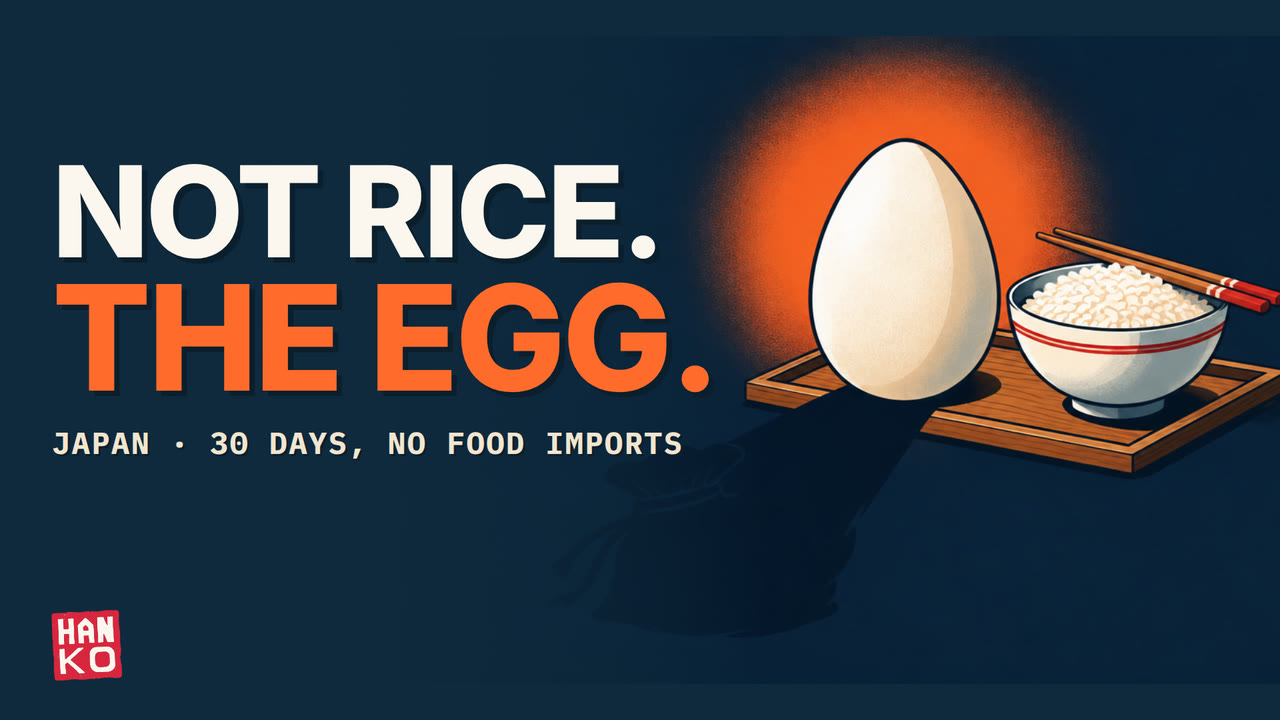
In our scenario, where every food and animal-feed import into Japan stops for 30 days, rice stays plentiful and, by our calculation, calories are not the main problem in the first month (our math). The first everyday staple likely to run short is the egg. Japan grows only about 37% of the calories it eats (MAFF), and while 96% of its eggs are laid in Japan, only about 11% count as home-grown once imported feed is included (MAFF).
The rules of the scenario and the starting point
This is a modelled what-if built from real data. Nothing in it is happening, and no country is named as the cause. On Day 1, all food and feed shipments stop and nothing arrives, not even ships already at sea. Official wheat planning assumes about two months of cargo is in transit (MAFF). Fuel and fertilizer keep coming.
The starting point is official FY2025 data. Japan’s food supply works out to 2,237 calories per person per day, and only 830 are grown in Japan once imported feed counts as imported (MAFF). By our calculation, about 1,400 calories a day, roughly 63%, come from abroad (our math).
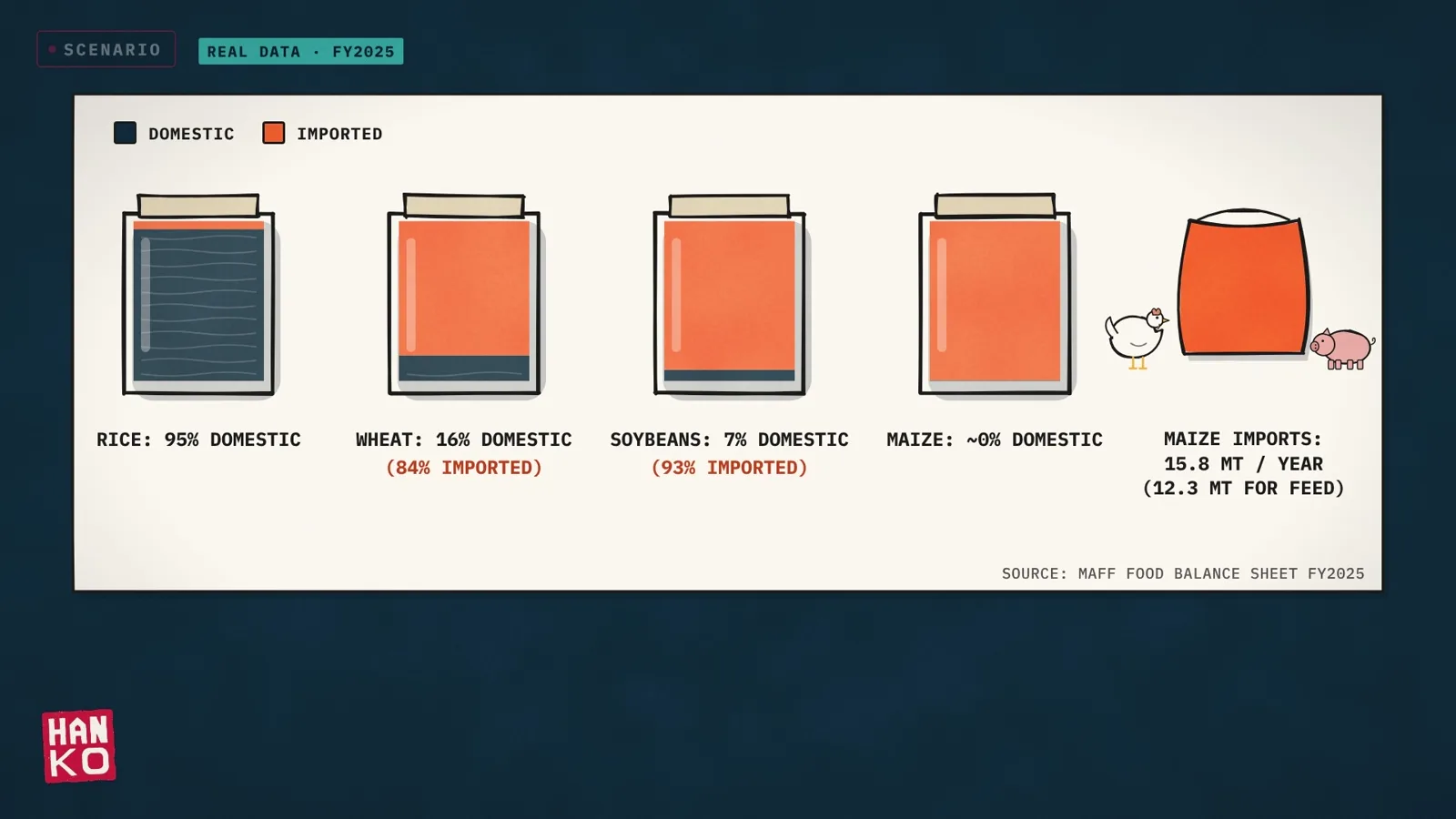
Rice is 95% home-grown by weight, wheat 16% and soybeans 7% (MAFF). Maize is almost entirely imported: 15.8 million tonnes in FY2025, 12.3 million of it for animal feed (MAFF). The map is lopsided too. In FY2024 (preliminary), Hokkaido grew 227% of the calories its people eat, while Tokyo stood at 0% and Osaka at 1% (MAFF). The biggest cities are fed from the ports.
Day 1: the first shortage is shopping
By our calculation, Japan now misses about 43,000 tonnes of maize, 15,500 of wheat and 9,200 of soybeans a day (our math). In the shops, the first shortage is likely buying, not a real lack of food.
In August 2024, rice ran short on many supermarket shelves. Private rice stocks had fallen to 1.56 million tonnes by the end of June, and an official earthquake advisory set off hoarding and panic buying (Japan Agricultural Research Institute). MAFF’s own review later found that production had fallen short of demand (MAFF). Homes hold little: in a March 2024 survey of 3,500 adults, the most common answer was two to three days of food (43.5%), and 37.4% keep no emergency food (Norinchukin Bank).
Day 2: the emergency food law
On Day 2, by our assumption, the government turns to a law in force since 1 April 2025 (MAFF). Its first stage applies when supply of a key food such as rice, wheat or soybeans falls, or may fall, at least 20% below normal. A headquarters of the prime minister and all ministers then makes requests: release stocks, adjust sales, sell at home instead of exporting (MAFF).
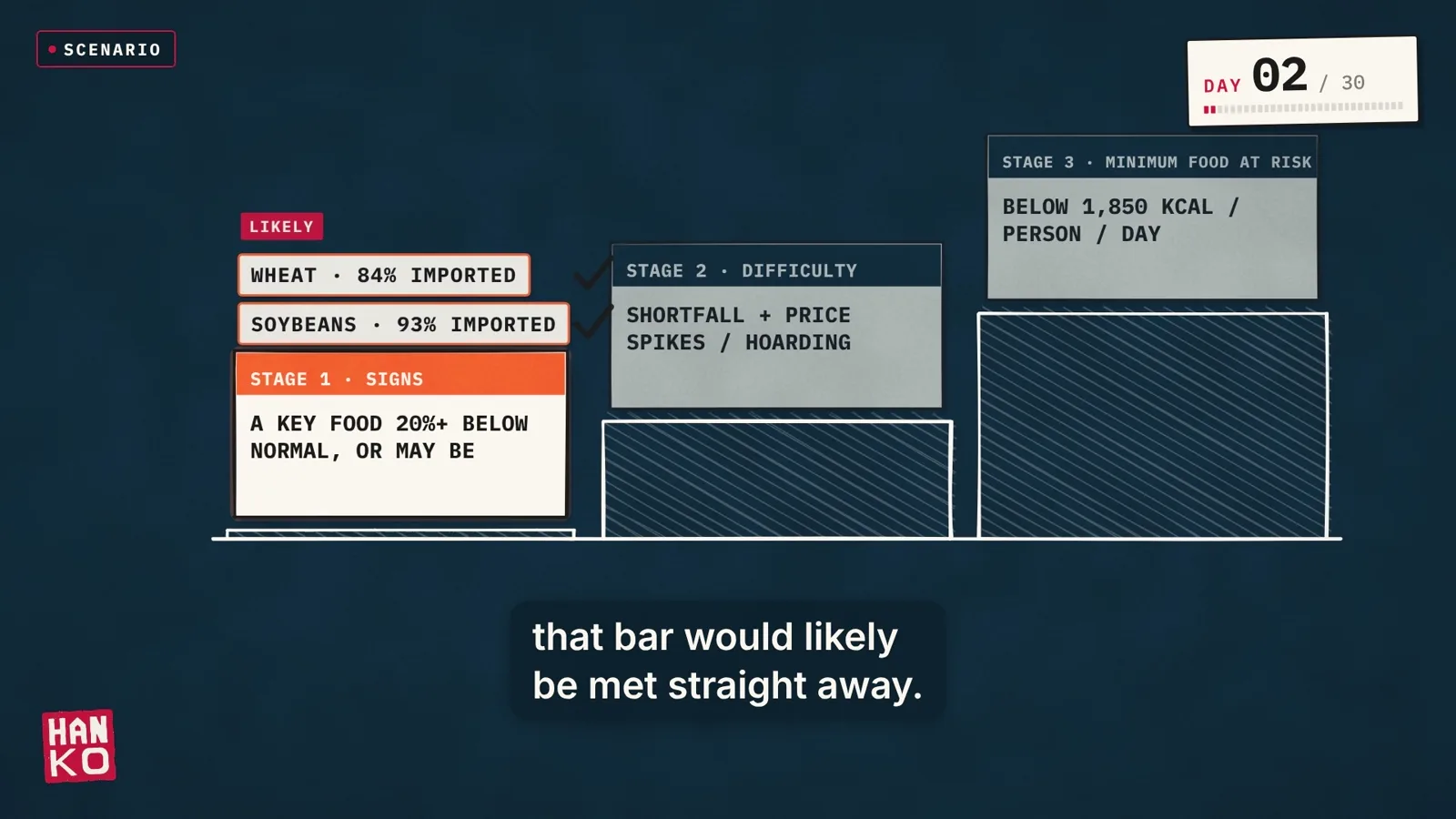
With wheat 84% imported and soybeans 93% (MAFF), that bar would likely be met straight away.
Day 3: the fresh aisle
The first real gaps would likely appear among imported fruit, which does not keep. Japan imported about 1.06 million tonnes of bananas in 2025, 8.6 kg per person (Japan Banana Importers Association), and fruit is only 38% domestic (MAFF). No official days-of-cover figure exists, so this is our inference.
Most of the aisle is local: vegetables are 77% domestic and fish and seafood 53% (MAFF). Vegetable seed is about 90% grown abroad, but about a year’s supply is kept in Japan (MAFF).
Day 5: bread, noodles and tofu
Japan holds about 2.3 months of demand for imported food wheat, with the state subsidizing storage on 1.8 months (Cabinet basic policy). By our calculation that is about 70 days even with no ships at sea (our math), so bread and udon last past Day 30, though prices would likely rise.
Soybeans are harder. Tofu, miso, soy sauce and soybean oil mostly start as imported beans, and stocks held by makers are not published (Cabinet basic policy). Between December 1972 and February 1973, wholesale soybean prices rose 133% and tofu prices 36% (MAFF).
With price spikes and hoarding, the law’s second stage would likely apply. If requests fail, ministers can instruct larger businesses, from importers to big farms, to file plans for sales, imports and production, and then to change them (MAFF). Not filing carries a fine of up to ¥200,000; there is no penalty for failing to grow more (MAFF).
Day 7: the rice twist
The food people worry about most is the one Japan has the most of. Private warehouses held a record 2.43 million tonnes of brown rice at the end of June 2026, up from 1.55 million a year earlier (MAFF; Nikkei). In the week of 14 September 2026, 5 kg of supermarket rice cost ¥2,934, down about 31% on a year before (MAFF). Japan has been truly short before: in 1993 the crop index fell to 74 and Japan arranged about 2.5 million tonnes of emergency imports (MAFF).
By our rough math, the calories Japan normally imports add up to about 5.2 trillion over 30 days, equal to about 1.5 million tonnes of polished rice (MEXT; our math). Private stocks at their June low held 2.16 million tonnes (MAFF). That counts calories only, not protein, fat or vitamins. The weak spot is the government reserve: 320,000 tonnes in July 2026 against a target of about 1 million (MAFF; Cabinet basic policy), expected to reach just under 600,000 after a September 2026 buy-back (Nikkei).
Day 10: what our food eats
Pigs and chickens live entirely on concentrate feed (MAFF), and only 11% of that concentrate is grown in Japan (MAFF). Maize is about half of compound feed, milled at 102 feed mills, mostly in port areas (MAFF).
The emergency feed-grain stock is about 1 million tonnes, roughly one month of demand (Cabinet basic policy), held on top of unpublished working stock (MAFF). By now, feed would likely be rationed. In 2011, the earthquake and tsunami knocked out ports with about 15% of compound-feed capacity and pig and broiler producers ran short; the plan was for other mills to ship feed in (USDA FAS). Here, there is no extra grain to ship.
For poultry, brown rice has the same energy as maize, 3.28 kcal per gram, and with the feed adjusted it can replace all of the maize; yolks turn paler (NARO). It does not replace the protein in soybean meal. By our calculation, a month of maize equals about 1 million tonnes of rice, about 40% of private stocks (our math).
Day 14: the egg problem
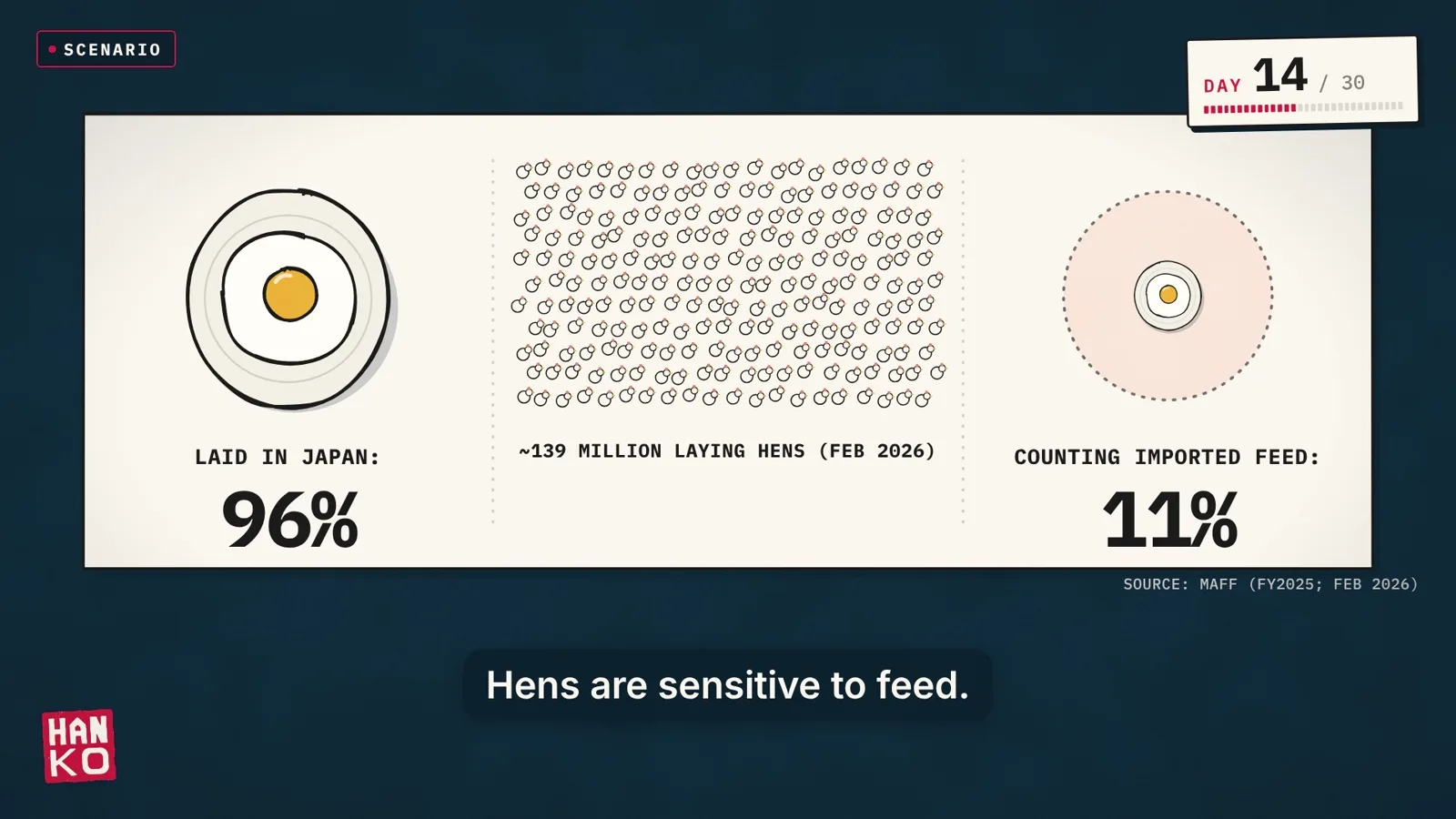
Japan’s eggs come from about 139 million laying hens (Minna no Nogyo Hiroba), but about 9 in 10 of their meals come from abroad (MAFF). In 2008 trials in which older hens’ rations were cut on purpose, laying stopped, or fell to 10-20%, within two to three weeks (NARO / Kagawa; Kagawa Livestock Experiment Station). Unlike rice, eggs cannot be stockpiled (Cabinet basic policy).
By our estimate, if rations were cut hard from around Day 10, egg supply could start falling between about Day 24 and Day 30 (our math).
Day 21: the meat counter and the milk
Cold stores held an estimated 166,000 tonnes of chicken, 243,000 of pork and 145,000 of beef at the end of July 2026 (ALIC). By our rough math, that covers the missing imports for about 80 days of pork, 90 of chicken and 100 of beef, but only if Japan’s own farms keep going on imported feed (our math). Broilers reach market weight in about 50 days (MAFF), so feed decisions show up on shelves weeks later. At the most severe stage, the government’s plan says it would consider planned, orderly slaughter, depending on the feed shortfall (Cabinet basic policy).
Dairy cows eat about half (47-53%) concentrate (MAFF); the rest is mostly grass and hay, which is 79% domestic, and drinking milk is entirely domestic (MAFF). Milk output would likely dip but not vanish.
Day 30: rationing exists, but for a worse crisis
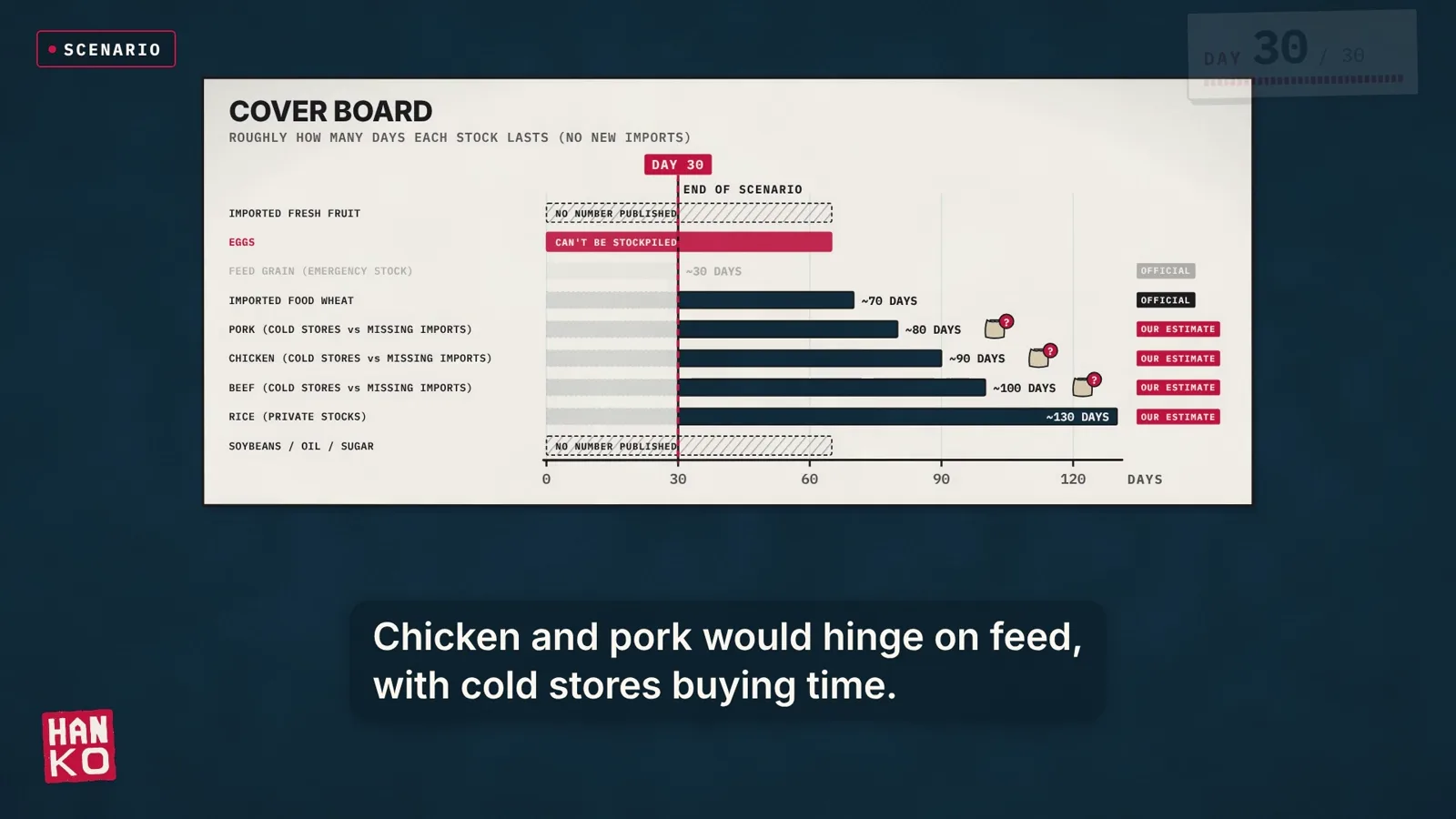
The feed stock, about a month’s worth (Cabinet basic policy), would be running low even rationed. Eggs would likely be running short, chicken and pork would hinge on feed with cold stores buying time, bread and noodles would still be on shelves, and rice would be plentiful.
Rationing sits in the law’s third stage, which applies only if supply threatens to fall below 1,850 calories per person per day (MAFF). The government could then control prices, ask farmers to switch to high-calorie crops, and allocate and ration food under older laws, including one from 1973 (MAFF; Cabinet basic policy). The 2025 law did not create a new rationing system (MAFF). Our judgement, not an official forecast: with rice stocks released in an orderly way, a 30-day stop need not cross that line.
After Day 30: the potato menu
Ships returning on Day 31 would not fix things overnight. In the trials, after full feed returned, hens took another two to four weeks to reach a 50% lay rate, about one egg every other day (Kagawa Livestock Experiment Station). By industry figures, feed maize takes about seven weeks from farm to Japanese port (MAFF council).
If it never ended, an older government illustration from around 2014 sketches an all-domestic diet: roasted sweet potatoes at breakfast and lunch, boiled potatoes with dinner, an egg every 7 days and meat every 9 days (MAFF). The most recent estimate, published in 2024 for FY2023, says potato-centred farming could supply 2,362 calories per person per day against a need of 2,167, and rice- and wheat-centred farming only 1,752 (MAFF). It assumes farmland is already replanted and ignores the time that takes (MAFF). It describes a long crisis, not month one.
What 30 days reveal
Back in the real world, Japan’s weak point is not rice. It is a dependence on imported grain that becomes eggs, chicken and pork.
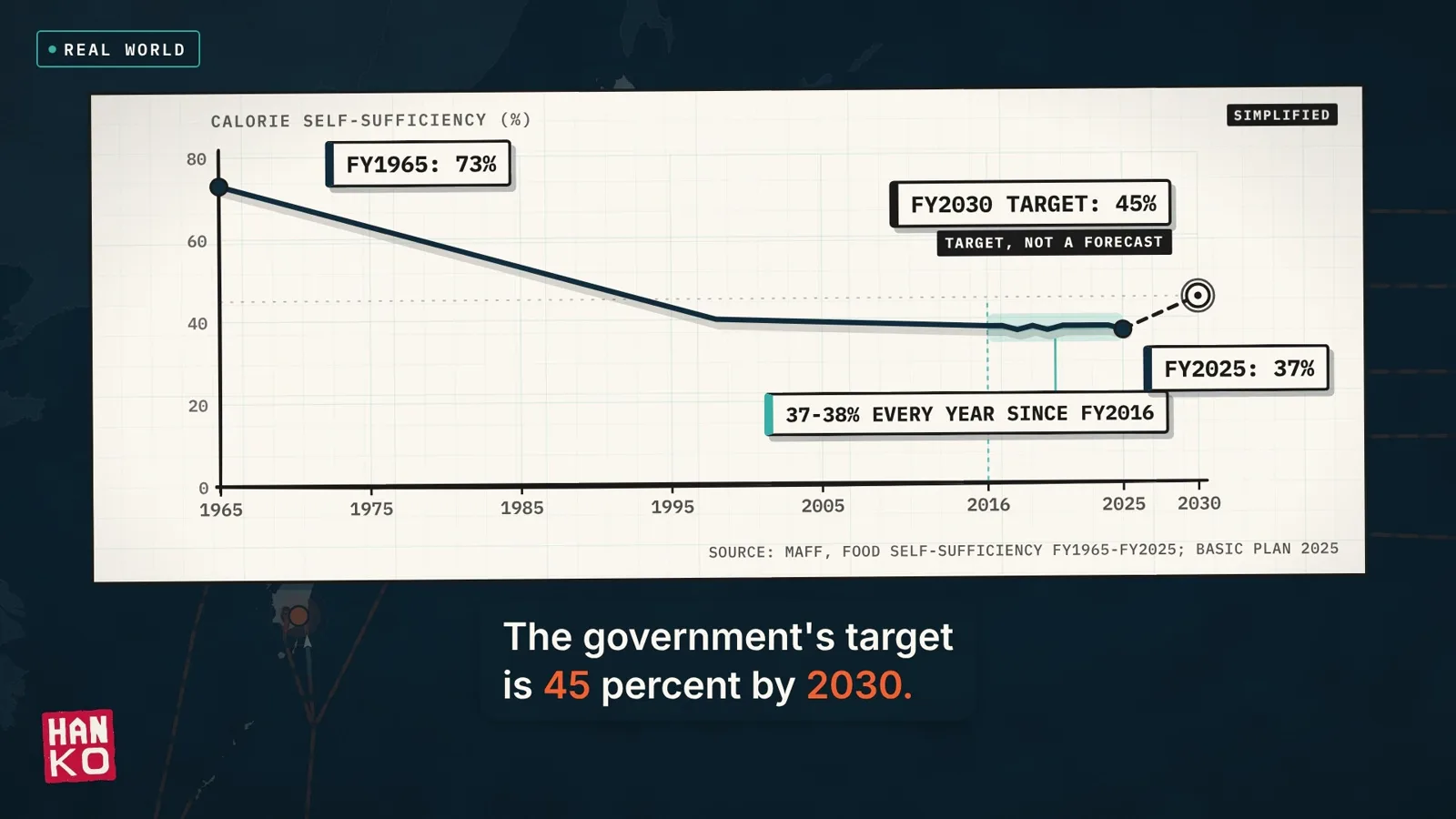
In FY1965, Japan grew 73% of its calories. Every year since FY2016 the figure has been 37% or 38%, and it was 37% in FY2025 (MAFF; MAFF). The government’s target is 45% by FY2030 (MAFF). On the breakfast tray, the rice was not the fragile part this time. The egg was.
The other Day by Day scenario follows a different chokepoint: what would happen if the Strait of Malacca closed.