
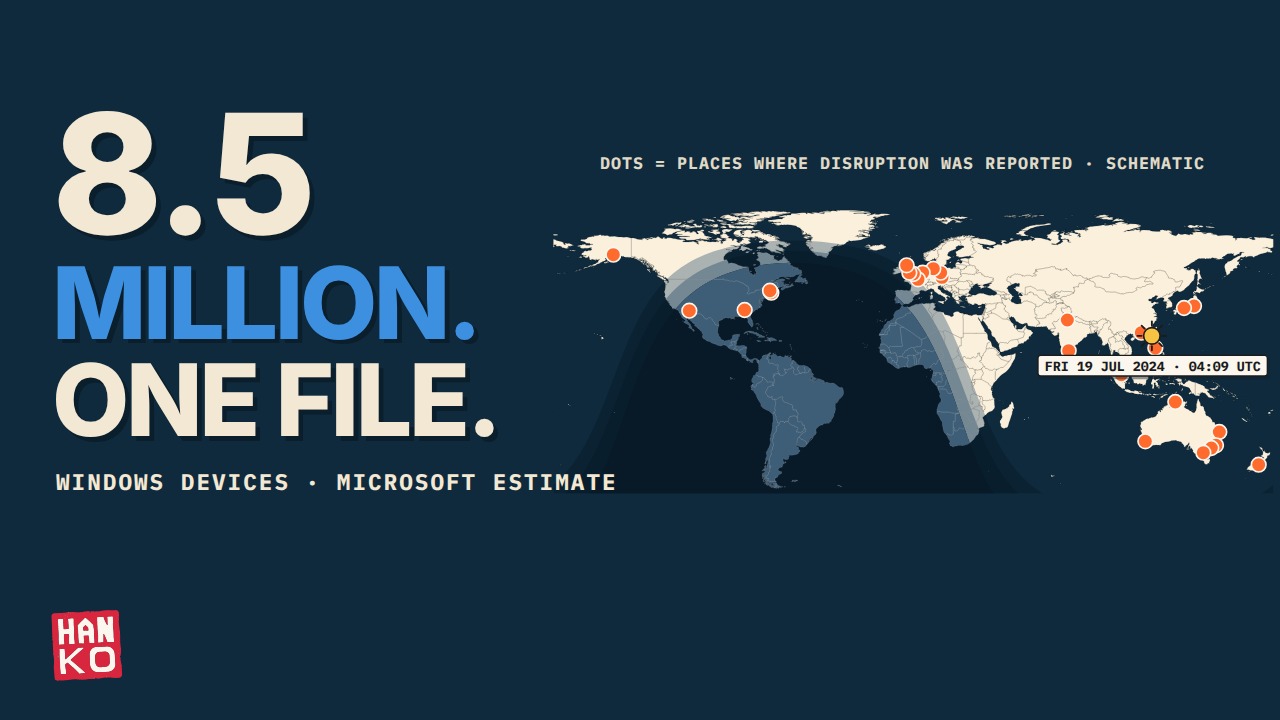
On Friday 19 July 2024, at 04:09 UTC, CrowdStrike sent a routine update for its Falcon security software to Windows computers, and pulled it at 05:27 UTC: the bad file was live for 78 minutes, by our calculation (CrowdStrike; our math). Microsoft estimated that it affected about 8.5 million Windows devices, less than 1% of all Windows machines (Microsoft). Those 78 minutes are not the length of the outage. A computer that had crashed often could not stay up long enough to download the fix, so many, though not all, had to be repaired by hand, and recovery took days (CrowdStrike; Microsoft).
This is a real event. Times are UTC unless a local zone is given; local times are our conversions (our math). “Reportedly” marks news-only items, and “by” marks a news post’s publication time.
A routine file, live for 78 minutes
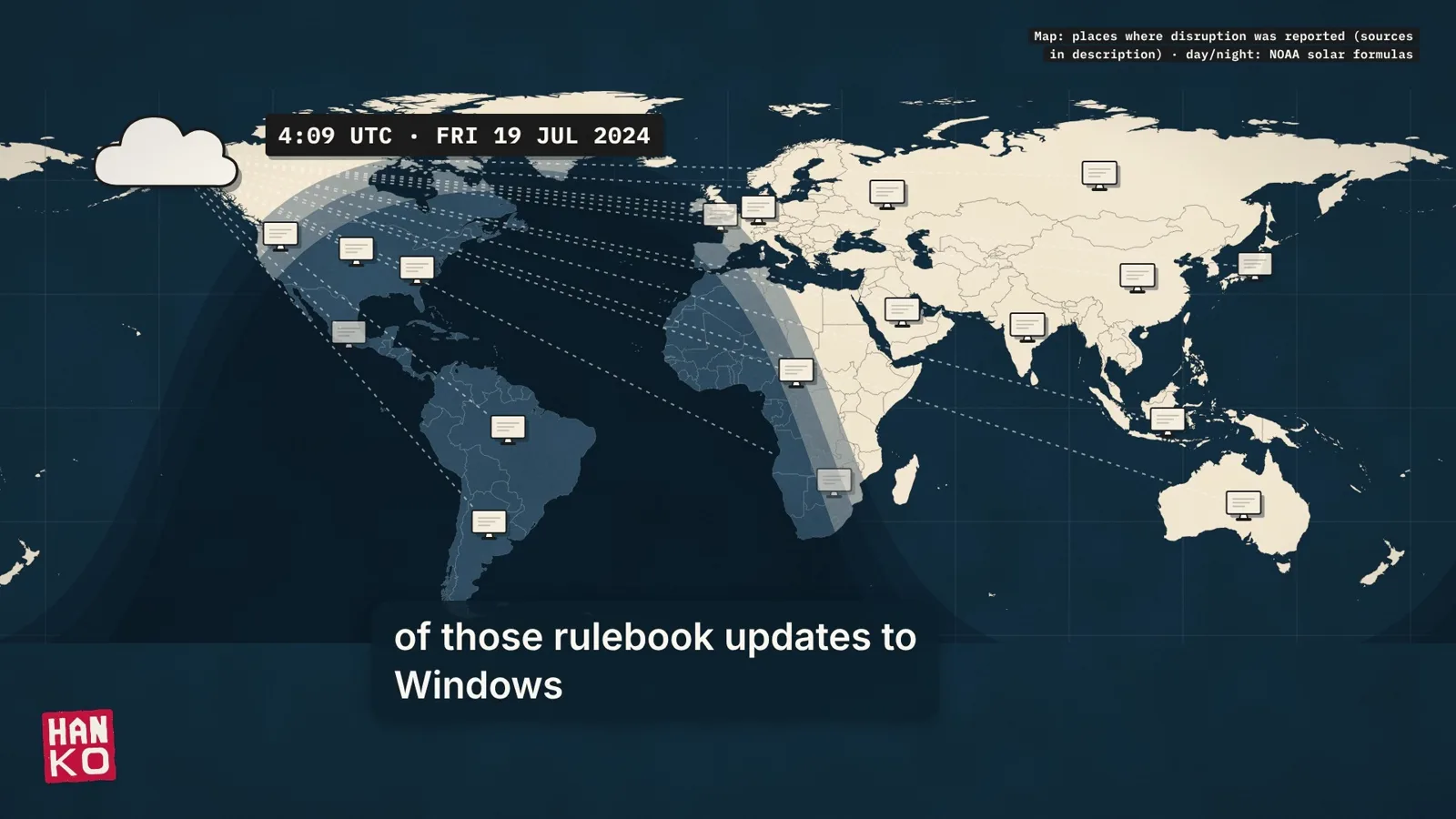
CrowdStrike sells Falcon to businesses and other organisations. Its sensor works in the kernel, the core of Windows, and loads early in start-up so it can catch harmful software before it gets going (CrowdStrike). To know what to look for, it receives new content files several times a day (CrowdStrike). These are configuration data, not a program or a kernel driver (CrowdStrike).
At 04:09 UTC it was 2:09 pm in Sydney, 1:09 pm in Osaka, 5:09 am in London, 12:09 am in New York and still 9:09 pm on Thursday in Los Angeles (our math). The update, a new version of Channel File 291, could crash Windows machines running sensor version 7.11 or later that were online between 04:09 and 05:27 UTC and received it. Machines that came online later, and Mac and Linux machines, were not affected (CrowdStrike; CrowdStrike).
About 8.5 million, and less than 1%
Microsoft gave its estimate on 20 July: “We currently estimate that CrowdStrike’s update affected 8.5 million Windows devices, or less than one percent of all Windows machines” (Microsoft). It has not published how it counted; the crash reports it receives are a sampled subset of affected devices (Microsoft). We found no public map of where the machines were.
The impact was large, Microsoft wrote, because CrowdStrike is used by “enterprises that run many critical services” (Microsoft). Many of the machines ran airports, banks and hospitals.
Hour by hour, around the world
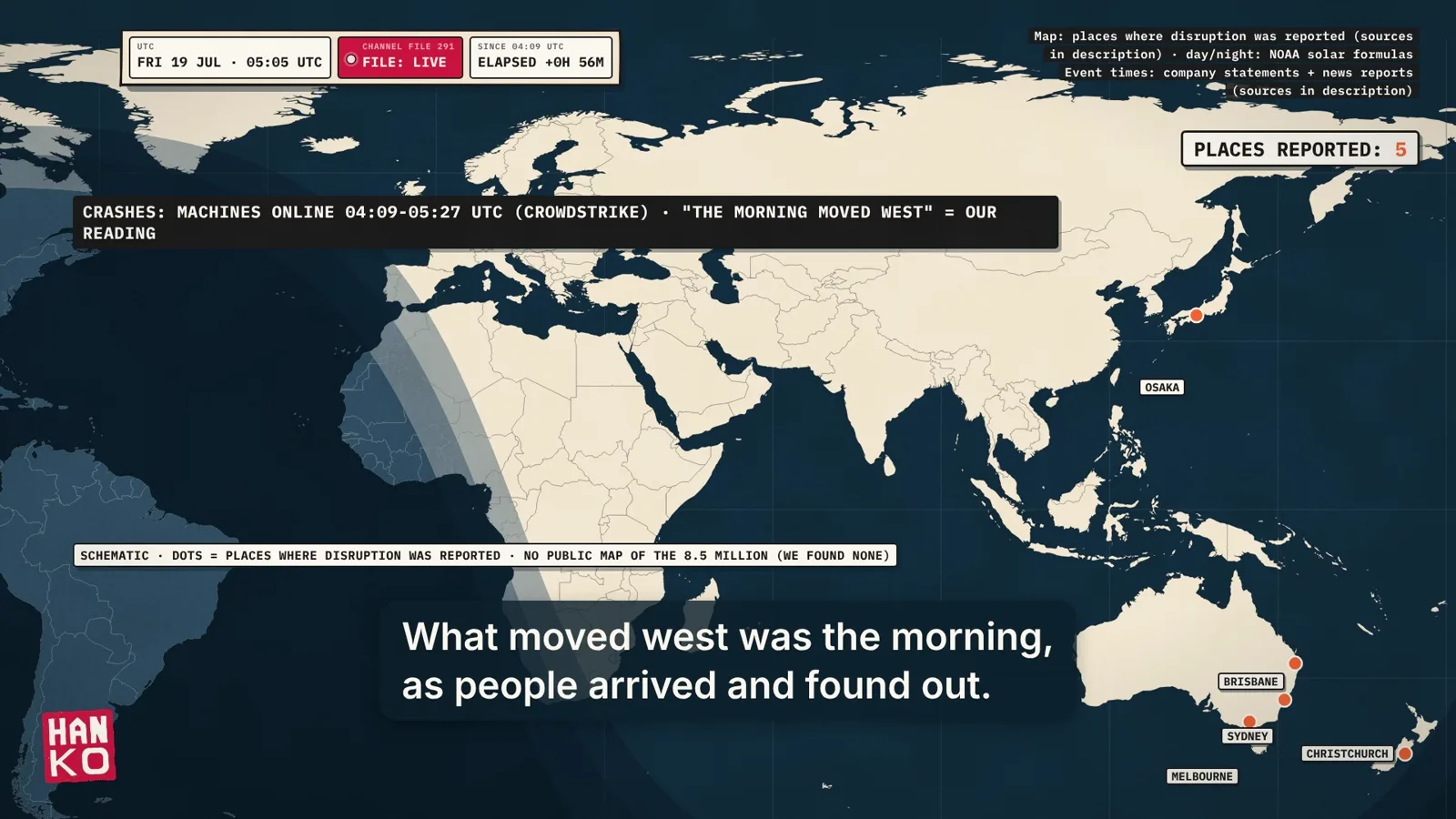
The crashes did not travel west with the sun. They began on machines online while the file was live, wherever they were (CrowdStrike). What moved west, in our reading, was the morning, as people arrived and found out.
Australia, mid-afternoon. Reports began flooding in at about 3 pm AEST, the ABC said; the national cyber security coordinator put the start at about 3:30 pm (ABC; SBS). Card payments, banking, supermarket checkouts and airport check-in were hit, and some businesses shut their doors. The ABC’s own video playout failed, so its news channel switched to live studio bulletins (ABC). New Zealand banks reported problems with payments and online banking (RNZ).
Japan, early afternoon. At Universal Studios Japan in Osaka, tills showed error screens from about 2 pm, and by about 2:30 pm every shop and restaurant in the park had stopped selling. “We’re treating them one by one, so it takes time,” the park said (our translation); it planned to open as normal the next day (ITmedia).
India to Europe, morning. Airline check-in at Bengaluru airport was reportedly down from 10:40 IST (PTI). Airports in Hong Kong and Singapore said some airlines had gone back to manual check-in (NBC News). At Berlin’s airport, reportedly, nothing took off or landed for part of the morning (t-online). NHS England said a problem with EMIS, an appointment and records system, was disrupting most GP practices (NHS England). Hospitals in Kiel and Lübeck reportedly cancelled planned operations (Euronews).
The United States, overnight. New Hampshire’s statewide 911 service was reportedly interrupted from about 1 am to 3 am ET (NBC News). In Alaska, many emergency call centres reportedly were not working properly, and Mass General Brigham in Boston reportedly cancelled elective surgeries (ABC News US). By 2:48 am EDT, American Airlines and Delta had reportedly asked the FAA for a ground stop, and United held its departures too (ABC News US; ABC News US). A separate Microsoft Azure outage in the central US, from 21:40 UTC on 18 July, was not caused by CrowdStrike (Microsoft).
That Friday, about 5,000 of more than 110,000 scheduled flights had been cancelled worldwide, with more expected, Reuters reported, citing Cirium; about 1 in 22, by our calculation. Some 2,000 had been cancelled on the Thursday, “before the software issues” (Reuters; our math).
| UTC, 19 Jul | Local | Where | What happened |
|---|---|---|---|
| 04:09 | 14:09 AEST · 00:09 EDT | Worldwide | Update released (CrowdStrike) |
| ~05:00 | ~15:00 AEST | Australia | Reports begin, reportedly (ABC) |
| ~05:00 | ~14:00 JST | Osaka | USJ tills fail, reportedly (ITmedia) |
| ~05:00 | ~01:00 EDT | New Hampshire | 911 interrupted to ~03:00, reportedly (NBC) |
| 05:10 | 10:40 IST | Bengaluru | Check-in down, reportedly (PTI) |
| 05:27 | 15:27 AEST · 01:27 EDT | Worldwide | Bad file pulled (CrowdStrike) |
| ~05:30 | ~14:30 JST | Osaka | All park shops stop selling, reportedly (ITmedia) |
| by 06:48 | by 02:48 EDT | US | American and Delta ask FAA for ground stop, reportedly (ABC US) |
| morning | expected to ~10:00 CEST | Berlin | Flights halted, reportedly (t-online) |
| by 08:51 | by 09:51 BST | London | Sky News: no live TV, reportedly (PA) |
| by 12:23 | by 08:23 EDT | US | CrowdStrike’s CEO apologises on TV, reportedly (ABC) |
Why it crashed: 21 boxes, 20 values
CrowdStrike’s root cause analysis says the new type of check, built into sensor 7.11, defined 21 input fields, but the code that fed it supplied only 20 (CrowdStrike). Picture a form with 21 boxes, filled in from a list of 20. Earlier files, from March and April 2024, and the tests all put a wildcard, meaning “anything”, in the 21st box, so the gap stayed hidden (CrowdStrike; CrowdStrike).
On 19 July, the new file put a real value there. The sensor reached for a 21st value to compare against, past the end of the 20 it had, and read memory that was not there (CrowdStrike).
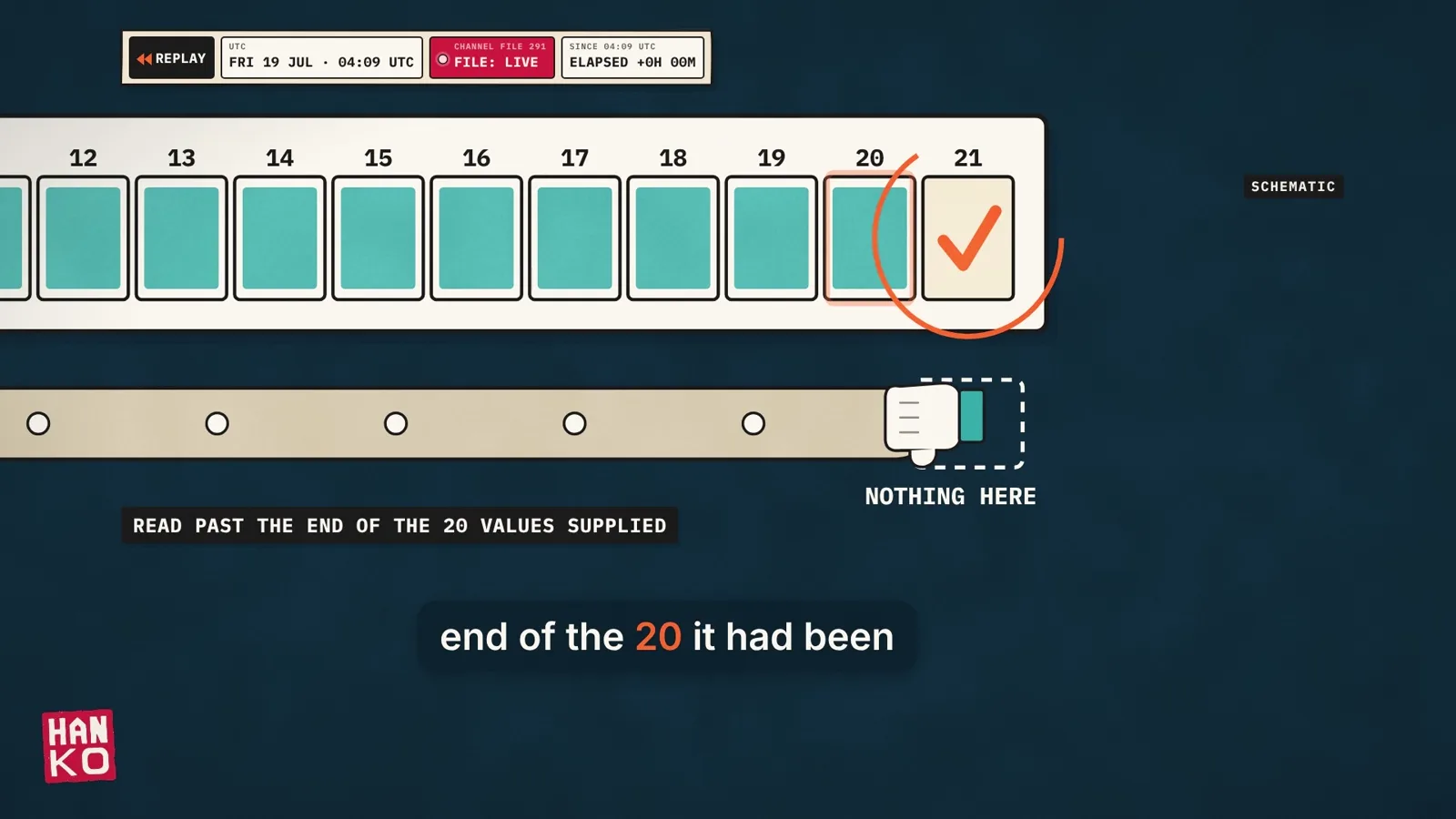
In an ordinary program, that would crash only the program. But the sensor runs in the kernel, and kernel code, Microsoft notes, “cannot fail and restart like a normal user application” (Microsoft). Windows stopped, showed a blue error screen and restarted. It was a mistake, not an attack: “This was not a cyberattack,” CrowdStrike’s chief executive wrote to customers that day (CrowdStrike).
Why fixing them took days
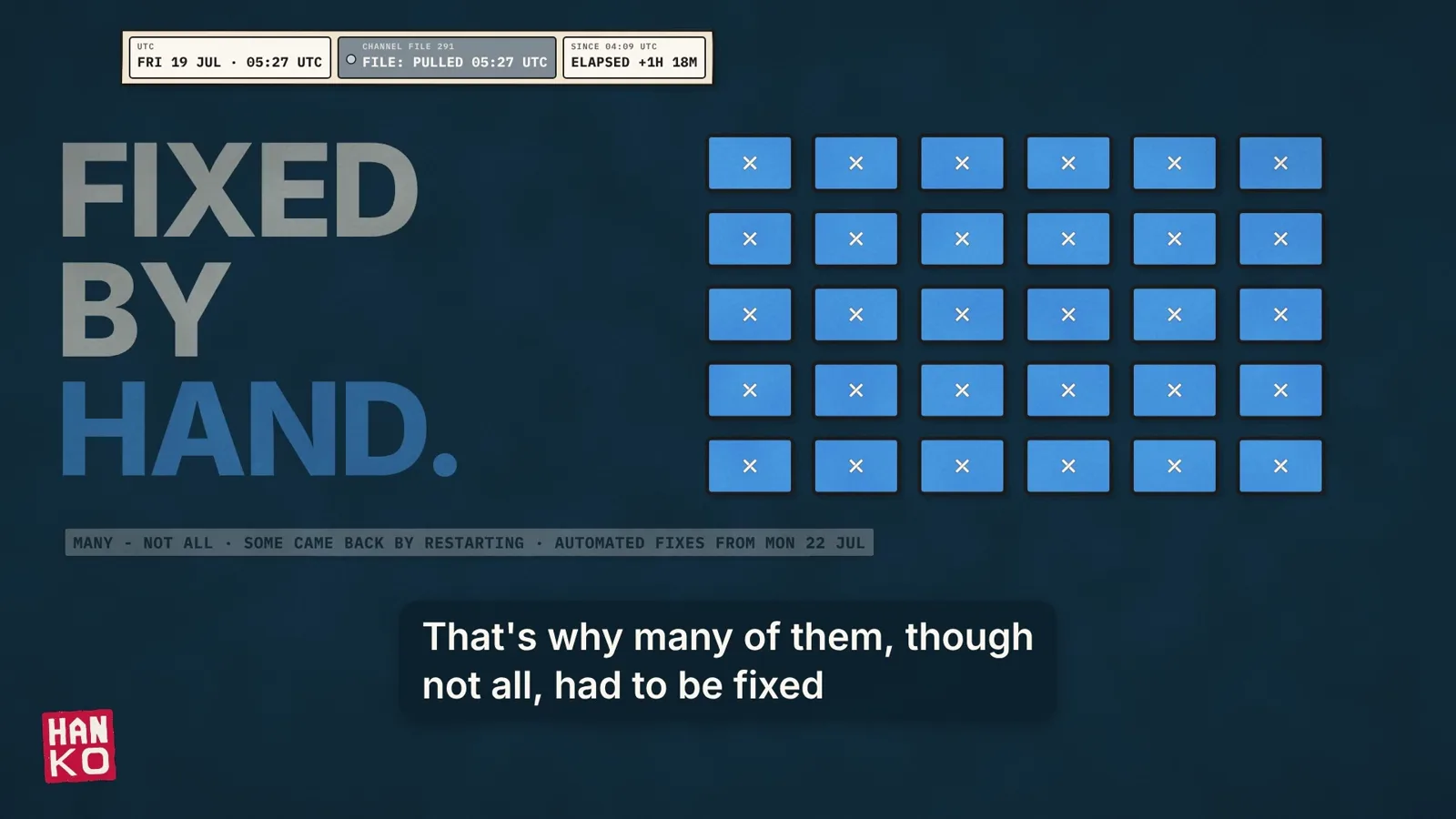
By the time Europe got to work, CrowdStrike had pulled the bad file and sent a corrected one (CrowdStrike). That did not help a machine that had already crashed. On restart, the sensor loaded early and read the bad file still on its disk, and crashed again. Many such machines were “unable to stay online to receive the Channel File update” (CrowdStrike).
Some came back on their own after several restarts (Microsoft). The simplest fix, in CrowdStrike’s guidance as updated on 21 July, was to restart, ideally on a wired network (CrowdStrike). Otherwise someone had to start each machine in a repair mode and delete the bad file (Microsoft). On disks encrypted with BitLocker, that often meant typing in the machine’s recovery key first (CrowdStrike; Microsoft). Microsoft’s USB recovery tool automated the steps, but it still had to be plugged into each computer (Microsoft). From Monday 22 July, CrowdStrike added automated fixes (CrowdStrike; US House). We found no source that gives the share of machines fixed by hand.
The week after
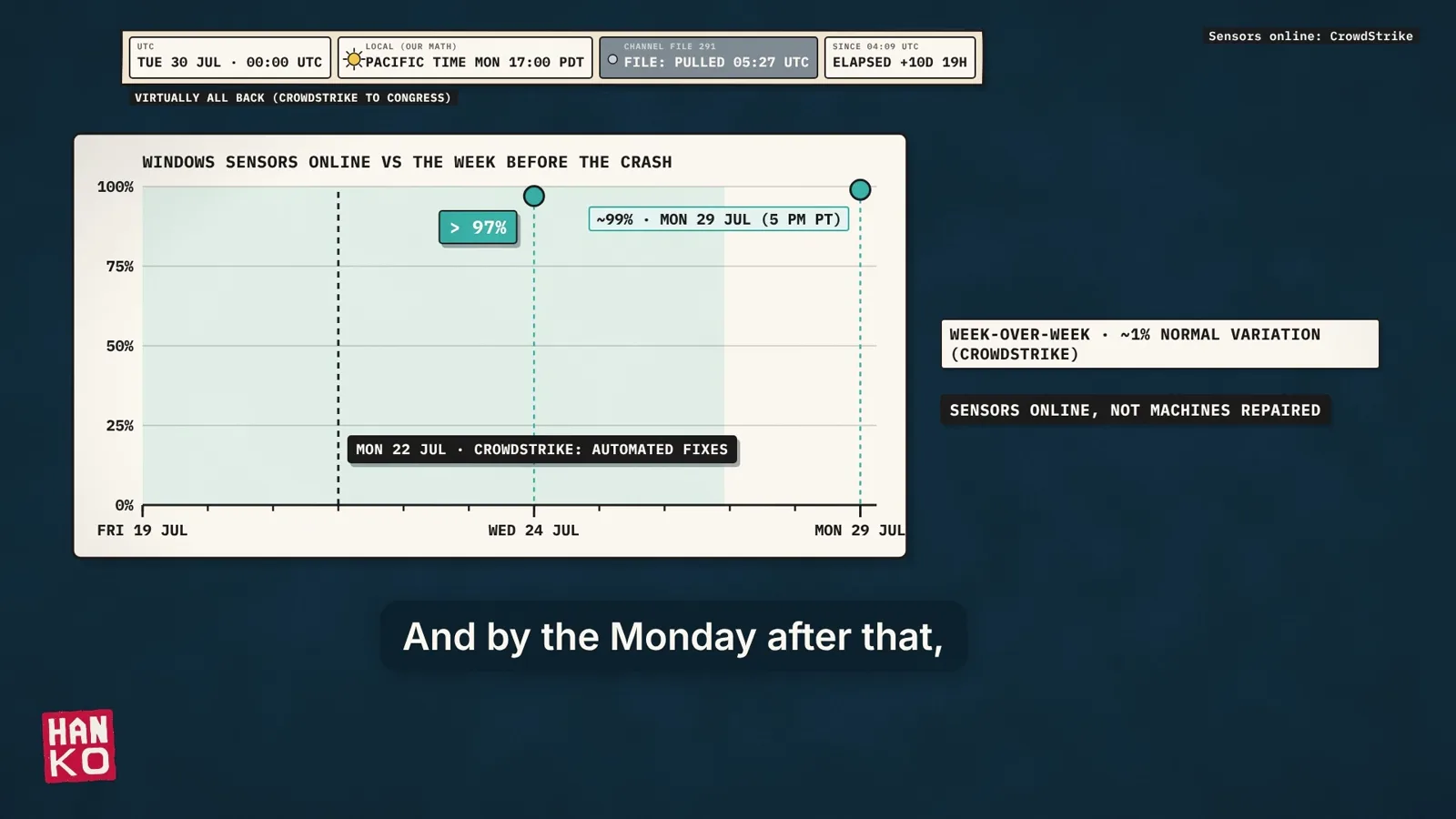
By Wednesday 24 July (5 pm PT), more than 97% of CrowdStrike’s Windows sensors were back online, compared with before the update; by Monday 29 July, about 99%. The comparison is week over week, with about 1% normal variation (CrowdStrike). Sensors online is not the same as machines repaired. “As of July 29, virtually all of our customers’ systems were back up and running,” a CrowdStrike executive told Congress (US House).
Squeeze those ten-odd days into one hour, and the file was live for about 18 seconds of it (our math).
Delta: five days, and a cause still debated
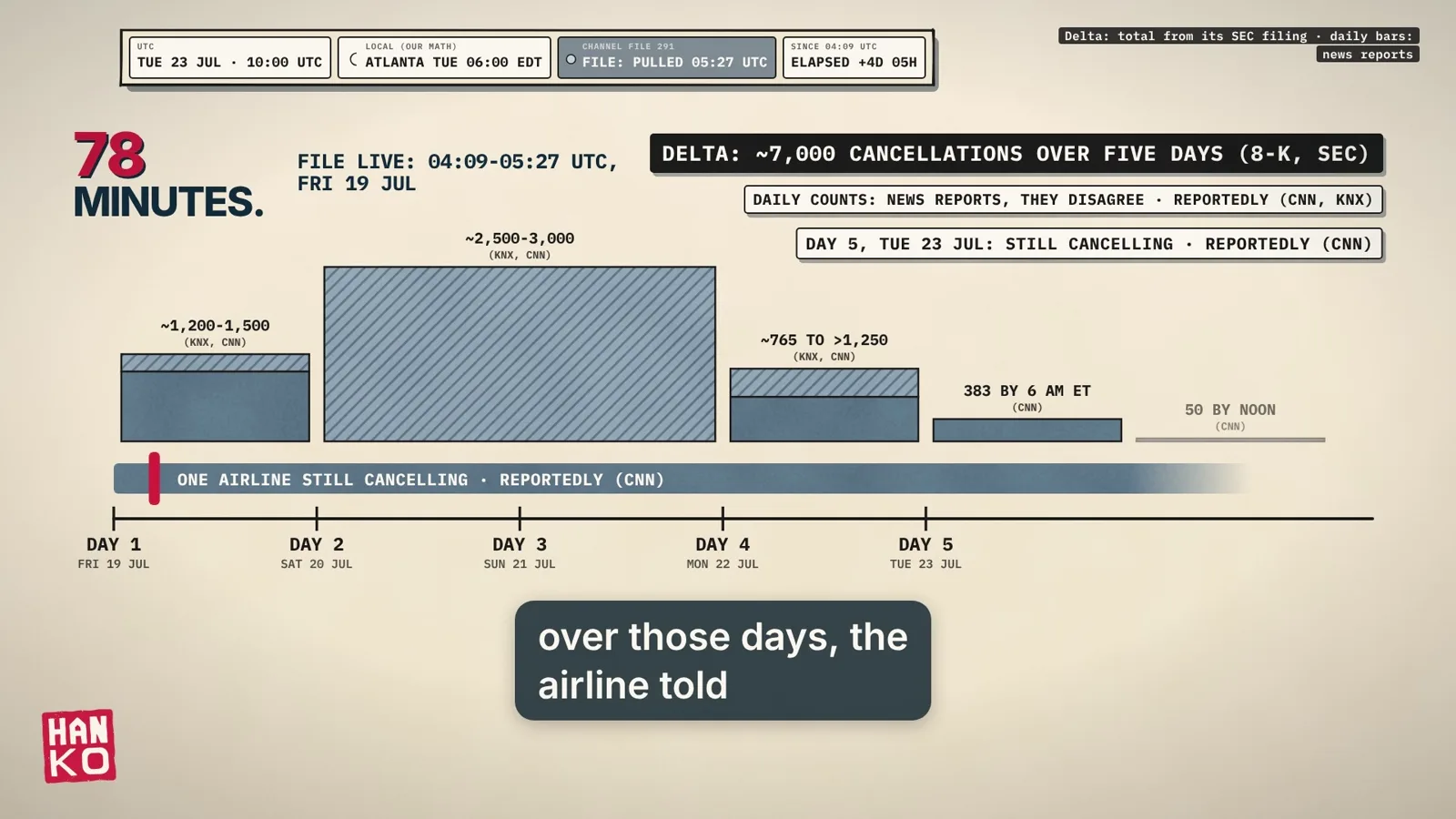
Most airlines recovered quickly, CNN reported; Delta was still cancelling flights on the fifth day, Tuesday 23 July, with 383 cancellations by 6 am ET (CNN; CNN). It expected a normal day on Thursday 25 July (The Fly). In all, Delta cancelled “approximately 7,000” flights over five days, it told investors (Delta).
Why Delta? This is debated. Delta’s chief executive said a crew-tracking tool was “unable to effectively process the unprecedented number of changes” (CNN). Microsoft, in an August 2024 letter, said Delta had “apparently not modernized its IT infrastructure”, and CrowdStrike, in its own suit, also blamed Delta’s IT (heise; Cyber Daily). Delta sued CrowdStrike in Georgia in October 2024. In May 2025 the court let part of the case go ahead, and “discovery is ongoing”; no court has decided who was at fault (CrowdStrike 10-Q). The US Transportation Department closed its probe of how Delta treated passengers without a penalty, Reuters reported (Reuters).
The bill
Delta said its damages from the outage total “at least $500 million”. Its filing put the revenue hit at about $380 million and extra non-fuel costs at about $170 million, with fuel about $50 million lower: about $500 million net, by our calculation (Delta; our math). The insurance firm Parametrix estimated direct losses at US Fortune 500 companies, excluding Microsoft, at $5.4 billion, with healthcare and banking hit hardest and no more than 10-20% insured (Parametrix). That is a model estimate for big US companies, not a global total.
CrowdStrike offered customers discounts, extra modules and services (CrowdStrike; CrowdStrike). Its shares fell 11.1% on 19 July (Yahoo Finance; our math).
What changed
CrowdStrike now releases these updates in stages, a few machines first, and lets customers choose when they land. It added the check that would have caught this one, comparing the fields a file asks for with the values the code supplies, and engaged outside firms to review its code; that work is ongoing (CrowdStrike; CrowdStrike; US House).
Since April 2025, Microsoft has required security vendors in its partner programme to roll updates out in stages (Microsoft; Microsoft). In August 2025 it released Quick Machine Recovery, which can send fixes to Windows 11 (24H2) PCs stuck at start-up; on Pro and Enterprise editions, IT administrators must turn it on (Microsoft; Microsoft). It has been testing a way for security software to work outside the kernel (a private preview since June 2025) but says it will keep supporting kernel drivers; by October 2026 we found no announcement that it had left testing (Microsoft; Microsoft; Microsoft).
A routine file, and a hidden mistake it exposed, put machines around the world into a loop they often could not fix themselves. For another day told hour by hour, see the day Japan’s stock market fell 12%.